About this visual
A closer look at what body-composition measurements do—and do not—tell us.
Sources & further reading
Original LinkedIn post and discussion ↗
Additional references appear in the infographic and the original LinkedIn discussion.
Originally posted Sep 2026 · By Joe Zucchi, PA-C, MPAS
1280 × 1600 px · PDF includes the original image and a link to this page.
A closer look at what body-composition measurements do—and do not—tell us.
Original LinkedIn post and discussion ↗
Additional references appear in the infographic and the original LinkedIn discussion.
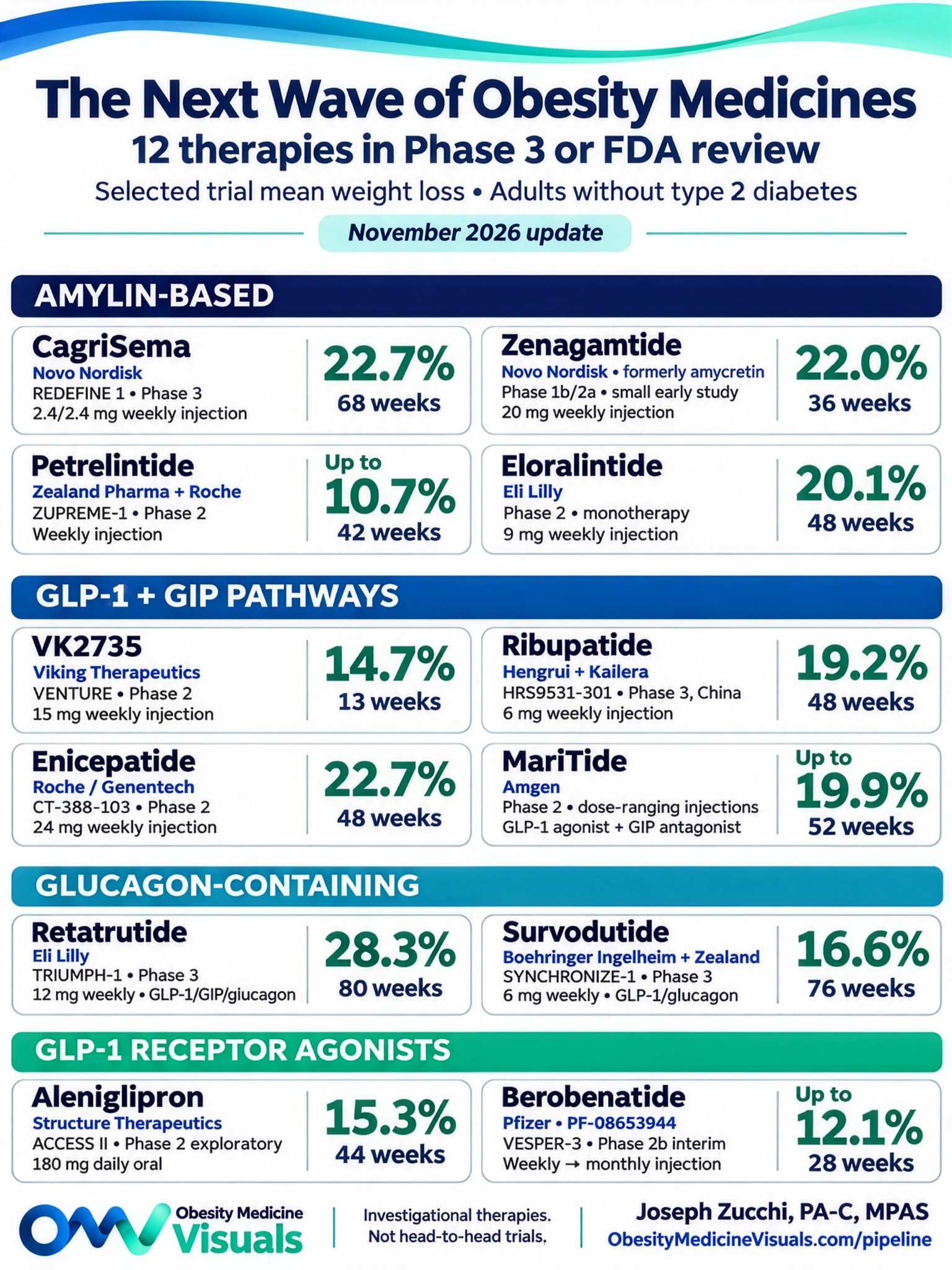
A November 2026 overview of 12 investigational obesity therapies, spanning amylin-based treatments, GLP-1/GIP pathways, glucagon-containing combinations, and GLP-1 receptor agonists.
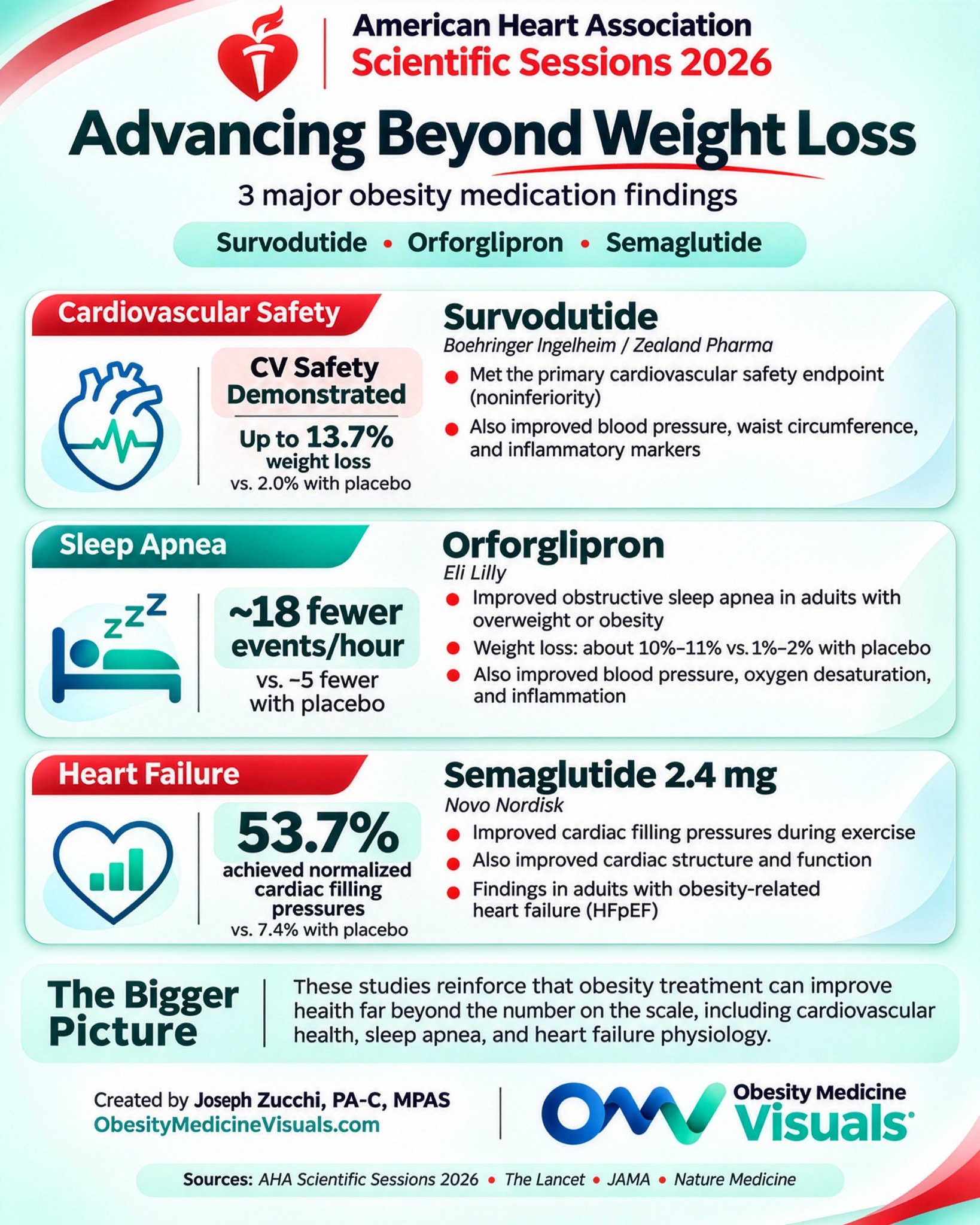
Three obesity medication findings from AHA Scientific Sessions 2026: survodutide and cardiovascular safety, orforglipron and sleep apnea, and semaglutide and obesity-related heart failure.
A six-slide overview of VK2735, covering injectable and oral Phase 2 results, exploratory maintenance dosing, dose-specific tolerability and Phase 3 programs.
One of the biggest misconceptions around GLP-1 medications is that “25–40% of the weight lost is muscle.”
That’s not actually what these studies show. They generally measure lean mass, and lean mass is not the same thing as skeletal muscle.
This came up yesterday during an excellent discussion from Angela Fitch MD, FACP, MFOMA, Dipl. ABOM, and it’s an important point we need to communicate better.
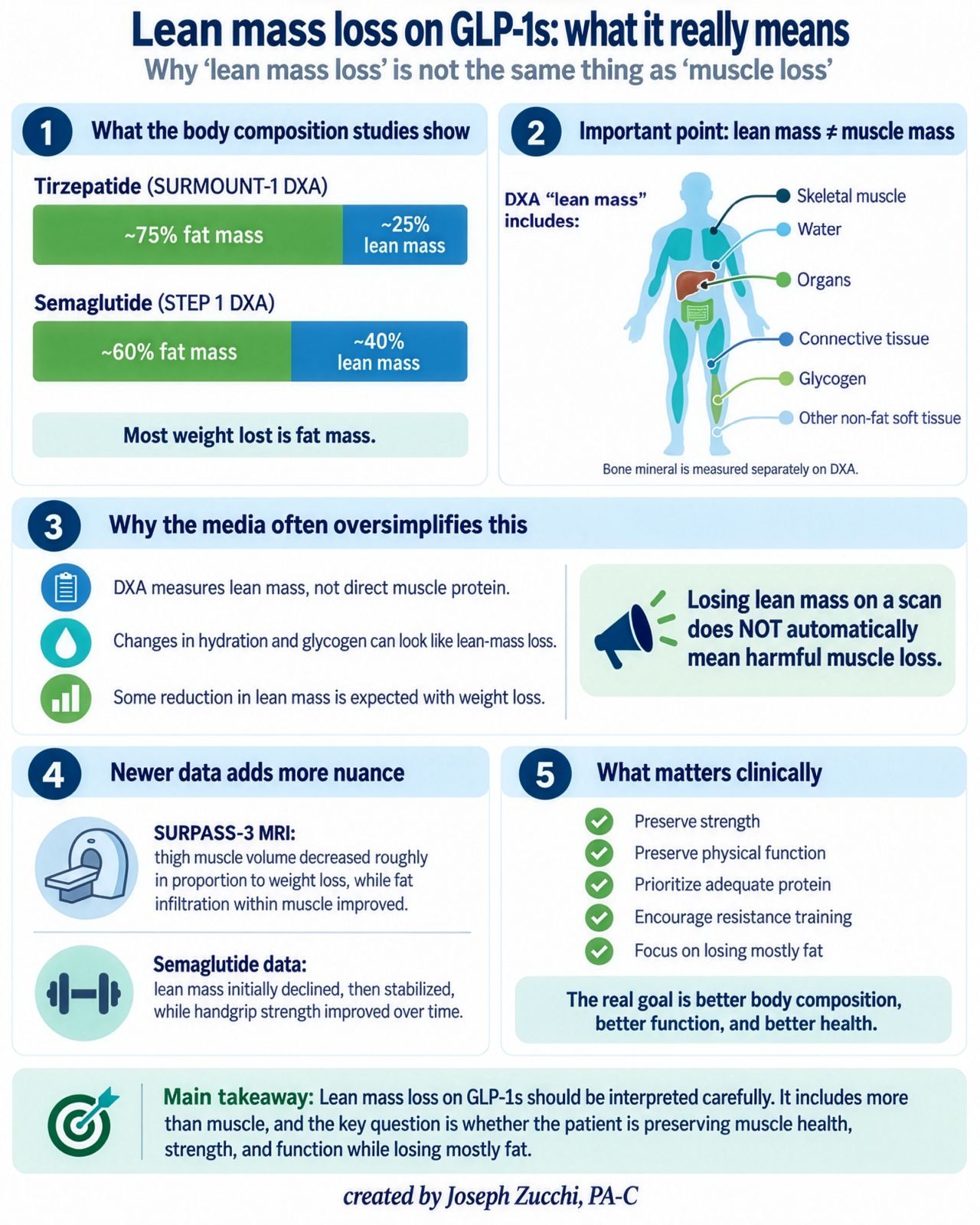
In the SURMOUNT-1 DXA substudy with tirzepatide, about 75% of the weight lost was fat mass and 25% was lean mass.
In the STEP 1 semaglutide substudy, it was closer to 60% fat and 40% lean mass.
A recent 2026 meta-analysis of 20 randomized trials (15,782 participants) found that the proportion of total weight loss coming from lean mass was:
- Semaglutide: 35.2%
- Tirzepatide: 25.4%
- Liraglutide: 26.8%
- Lifestyle intervention: 26.2%
- Lifestyle + resistance training: 17.5%
So some lean-mass loss is a normal part of significant weight reduction, even without medication. But the important point is that:
Lean mass ≠ muscle mass.
DXA-derived lean mass includes skeletal muscle, but it also includes water, organs, connective tissue and other non-fat soft tissue. DXA cannot tell us exactly how much of a change in whole-body lean mass represents actual contractile muscle tissue.
Water matters too. Changes in hydration and glycogen can show up as changes in DXA lean mass.
And muscle quality can actually improve while muscle volume decreases. A recent MRI analysis from SURPASS-3 found that tirzepatide did reduce thigh muscle volume, but the reduction was roughly what would be expected for the amount of weight lost. At the same time, fat infiltration within the muscle improved.
Someone losing 50 pounds does not necessarily need the same amount of skeletal muscle required to move a body that was 50 pounds heavier. The important aspects are whether we are preserving strength, physical function and muscle quality.
In fact, a recent study of semaglutide 2.4 mg found an initial decline in lean mass that later stabilized, while handgrip strength actually improved over 12 months.
This doesn't mean we should ignore muscle loss. We should absolutely emphasize adequate protein, resistance training and maintaining strength during obesity treatment.
But we also shouldn't turn every pound of “lean mass loss” on a DXA scan into a pound of lost muscle.
The goal isn't just to preserve a number on a body-composition scan. It’s to lose predominantly fat while preserving muscle health, strength and function.