
Visual library / Clinical Trials & Pipeline

Conference briefingWashington, DC · November 14–17, 2026

ObesityWeek 2026 Obesity Medicine Roundup

ObesityWeek brings clinicians and researchers together to share new obesity science. This year’s meeting runs November 14–17 in Washington, DC.

I’ve brought the key findings together here, with study summaries, safety context and original sources. Start with five clinical stories below. Updated through Tuesday, November 17.

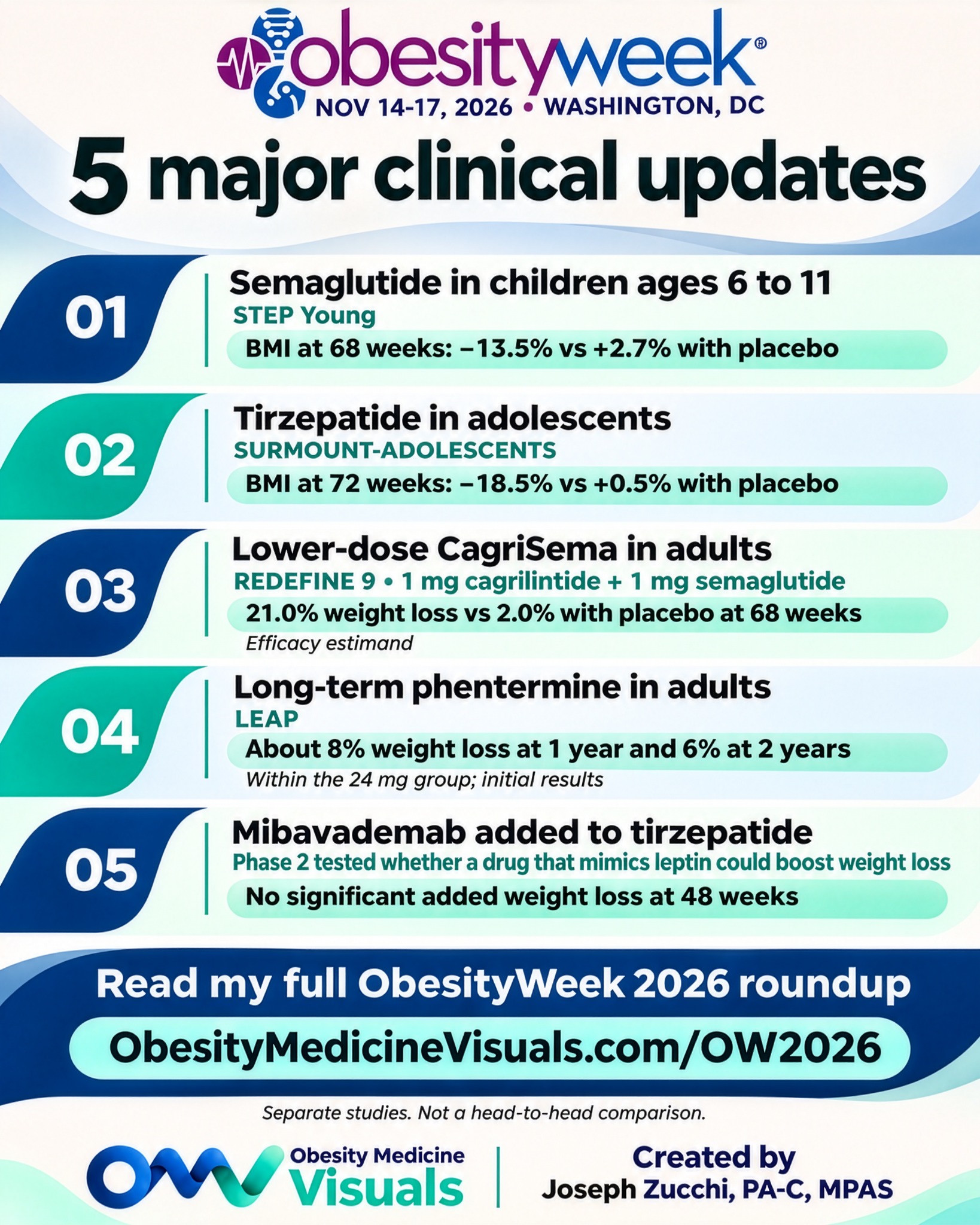
Five ObesityWeek 2026 clinical updates: semaglutide in children ages 6 to 11, adolescent tirzepatide, lower-dose CagriSema, phentermine and mibavademab with tirzepatide. Study details and safety context follow in the roundup.View full infographic ↗
Five clinical updates, with the full study context below.

Five clinical stories to start with

01

Pediatric obesity

Published trial

Semaglutide in children aged 6 to under 12

STEP Young · Phase 3 randomized trial · November 16 · New detail on earlier results

In 167 children aged 6 to under 12 with obesity, weekly semaglutide reduced BMI by 13.5% versus a 2.7% increase with placebo at 68 weeks in the primary analysis. Both groups received lifestyle support.

Semaglutide remains investigational in this age group. Children weighed more than 45 kg; dosing depended on weight and tolerability. Gastrointestinal symptoms were more frequent with semaglutide and led one participant to stop treatment. Longer-term growth and safety remain important.

Study design, results and safety

The trial randomized 167 children with obesity to weekly semaglutide (112) or placebo (55), both with lifestyle intervention. The registry required body weight >45 kg. Novo describes target maximum weekly doses of 1.7 mg at 45–60 kg and 2.4 mg above 60 kg, or the maximum tolerated dose. These data do not establish dosing in children weighing 45 kg or less.

At week 68, primary treatment-regimen BMI change was −13.5% versus +2.7%: difference −16.2 percentage points (95% CI −19.4 to −12.9). The separate efficacy-estimand estimates were −17.4% versus +2.2%: difference −19.7 points (−23.1 to −16.2).

At week 104, supportive treatment-regimen BMI changes were −9.4% versus +8.4%; the separate efficacy estimates were −14.0% versus +5.7%. These secondary results were not adjusted for multiplicity. Interpretation of the difference from week 68 requires the extension’s adherence and missing-data context.

The September finding that 40.4% versus 0% fell below the pediatric obesity threshold was already public and belongs to the efficacy analysis. Adult BMI cutoffs do not define obesity in growing children.

Safety: The journal abstract reports adverse events in 96% with semaglutide and 93% with placebo. GI events were the most common and occurred more frequently with semaglutide; they led to discontinuation in one semaglutide participant. These are not rates of persistent or severe GI symptoms. Longer-term growth, maturation and tolerability remain important when interpreting pediatric evidence.

Clinical context: Randomized evidence is expanding into younger ages. This is not a comparison with another medicine; semaglutide remains investigational for this age group.

Back to top ↑
Published trial

Tirzepatide in adolescents

SURMOUNT-ADOLESCENTS · Phase 3 randomized trial · November 15 · Full publication and safety details

The full SURMOUNT-ADOLESCENTS paper reports 18.5% BMI reduction versus a 0.5% increase with placebo at 72 weeks in the primary analysis of adolescents aged 12–17.

Vomiting occurred in 55/108 participants receiving tirzepatide versus 7/51 receiving placebo at some point during treatment. Gastrointestinal events were mostly mild to moderate and more frequent during dose escalation. These results cannot be compared directly with the younger-child semaglutide trial.

Study design, results and safety

The blinded trial randomized 160 adolescents aged 12–17 to weekly tirzepatide, maximum tolerated 5/10/15 mg, or placebo plus lifestyle intervention; 159 received treatment.

At week 72, primary treatment-regimen BMI change was −18.5% versus +0.5%: difference −19.0 points (95% CI −23.9 to −14.1). The separate efficacy estimate was −21.4% versus +0.4%.

Vomiting affected 55/108 (50.9%) versus 7/51 (13.7%) participants, counting treatment-emergent events rather than persistent/severe vomiting. GI events were mainly mild/moderate and more frequent during escalation. Vomiting prompted dose reduction in 10/108; separately, any AE prompted treatment discontinuation in 10/108 versus 0/51.

Growth/puberty interpretation and long-term safety remain limited. These trials cannot rank drugs across age groups.

Back to top ↑
02

Adult trials and dosing

Initial institutional report

LEAP: phentermine over two years

24-month randomized placebo-controlled trial · Initial institutional report · November 16, 9:30 a.m. EST

The initial LEAP report adds two-year randomized evidence for a low-cost oral medication. The phentermine 24-mg arm lost about 8% at one year and 6% at two years; these are not placebo-adjusted effects.

Mean heart rate rose 3–5 beats/minute. People with cardiovascular disease or uncontrolled blood pressure were excluded. The initial report does not provide the full placebo or dropout analysis, and the U.S. short-term label is unchanged.

Study design, results and safety

The NHLBI-funded LEAP trial compared phentermine 24 mg with placebo in adults with obesity; both groups received lifestyle support. The official symposium presented the 24-month trial on November 16.

Wake Forest reports approximately 8% weight loss at one year and 6% at two years in the phentermine arm. These are changes from starting weight, not placebo-adjusted effects.

Mean heart rate increased about 3–5 beats/minute. Mean blood pressure did not increase in participants whose baseline BP was controlled. Cardiovascular disease and uncontrolled hypertension were excluded; this does not establish safety in those populations or demonstrate cardiovascular-event safety.

Interpretation: This adds randomized long-duration evidence for a low-cost oral option. The institutional release is not a full peer-reviewed report and does not supply exact placebo estimates, analysis denominators, confidence intervals, attrition or estimand/missing-data methods. The U.S. short-term label is unchanged.

Back to top ↑
Published trial

Lower-dose CagriSema

REDEFINE 9 · Phase 3b randomized trial · November 14 · Full results after September announcement

In 309 adults without diabetes, lower-dose CagriSema produced 20.7% loss with 1.7/1.7 mg and 21.0% with 1.0/1.0 mg versus 2.0% with placebo at 68 weeks in the analysis assuming continued treatment.

The full report adds another dose, safety details and results that include treatment discontinuations to the September announcement. Gastrointestinal events were mainly mild to moderate. Similar average losses do not prove the doses are equivalent; the separate treatment-regimen results are below.

Study design, results and safety

The 68-week trial randomized 309 adults without diabetes, with obesity or overweight plus a complication, to weekly cagrilintide/semaglutide 1.7/1.7 mg (104), 1.0/1.0 mg (103), or pooled placebo (102), with lifestyle support. Blinding applied within dose levels; 308 received treatment.

Week 68 mean body-weight change
Analysis1.7/1.7 mg1.0/1.0 mgPlacebo
Efficacy−20.7%−21.0%−2.0%
Treatment regimen−19.4%−18.6%−4.6%

Efficacy-estimand differences versus placebo were −18.8 points (95% CI −21.5 to −16.0) and −19.0 points (−21.8 to −16.2). GI events were mainly mild/moderate. AE discontinuation was 2.9%, 4.9% and 4.9%, respectively.

What changed: September’s 1.0/1.0-mg result was already public. The meeting adds the detailed 1.7/1.7-mg result, treatment-regimen estimates, safety, corrected randomized N and publication.

Clinical context: The trial supports studying dosing flexibility; it was not powered to establish equivalence between doses. Similar means do not establish equivalent individual benefit or tolerability.

Back to top ↑
Published trial

Ribupatide: full GEMINI-1 publication

China Phase 3 · JAMA, November 15 · Full publication of an earlier topline

The full JAMA report gives 17.7% weight loss versus 1.4% with placebo at 48 weeks for weekly ribupatide 6 mg in the primary analysis. The trial included 567 adults in China without diabetes.

The weight-loss headline was announced in 2025. The paper adds methods and safety: gastrointestinal events occurred in 63.1% at 6 mg versus 23.1% with placebo. This is separate from the global KaiNETIC program.

Study design, results and safety

The 48-week trial enrolled 567 adults in China without diabetes, comparing weekly 2, 4 or 6 mg with placebo. Primary treatment-policy mean losses were 10.7%, 16.4% and 17.7% versus 1.4%. The 6-mg difference was −16.3 percentage points (95% CI −18.4 to −14.2).

At 6 mg, GI events occurred in 63.1% versus 23.1% placebo; adverse-event treatment discontinuation was 2/141 versus 0/143.

Interpretation: The headline was public in 2025. The full paper strengthens methods and safety review; it is not global KaiNETIC efficacy. Primary analyses used all randomized participants with multiple imputation; observed box plots are descriptive. The young, China-only population and small DXA substudy limit generalization; muscle strength was not assessed.

Back to top ↑
Conference evidence

Oral safiglipron

HARBOR-1 · Phase 3 sponsor posters · November 15 · Updated supplementary analyses

The primary HARBOR-1 result is unchanged: 9.79% weight loss versus 2.39% with placebo at week 44 for oral safiglipron 180 mg. November posters add analyses of people continuing treatment and later follow-up.

Those additional estimates answer different questions and are labeled separately below. Gastrointestinal events were common. Exploratory glucose findings do not establish diabetes prevention; China filing acceptance is review, not approval.

Study design, results and safety

The China trial randomized 556 adults without diabetes to oral safiglipron 90 mg, 180 mg or placebo for 50 weeks. The primary week-44 treatment-policy result remained −9.79% versus −2.39% for 180 mg versus placebo.

The November main poster gives prespecified supplementary week-44 efficacy estimates of −11.58% versus −2.54%. A separate ad hoc model gives −11.92% versus −2.65% at week 50. These should not be blended with July’s supplementary estimates or portrayed as a changed primary endpoint. The ad hoc model also produces different week-44 estimates.

GI tolerability remains relevant; AE discontinuation was 3.1% at 180 mg. An exploratory/imputed prediabetes subgroup found normoglycemia at week 50 in 45/60 versus 8/36. Nominal analyses and selected subgroups do not establish diabetes prevention.

Clinical context: These results refine an oral GLP-1 program. China filing acceptance is review, not approval; the global Phase 2 study is separate.

Back to top ↑
03

Outcomes beyond weight

Conference evidence

Early response and physical function

REDEFINE 1 · Phase 3 trial follow-up · November 15 · Post hoc analyses

Some people who lost less than 5% by week 8 still had substantial later loss with CagriSema. Among those with observed week-68 data, mean loss was 17.8%; 37.2% reached at least 20% loss.

A separate analysis found improved self-reported physical function. These follow-up analyses add clinical context, but they do not validate a stopping rule or predict an individual patient’s response.

Study design, results and safety

CagriSema-treated participants with less than 5% weight loss at week 8 who had observed week-68 data averaged 17.8% loss at week 68; 37.2% achieved at least 20% loss.

Slower early loss can coexist with substantial later loss, but selected observed-data analyses do not validate a stopping rule or predict individual response.

A separate efficacy-estimand patient-reported analysis found clinically meaningful physical-function improvement in 73.1% versus 49.1% with placebo. This was a separate analysis from the early-response subgroup and primary weight result.

Clinical context: Trajectory and function add information beyond mean weight change. Post hoc selection, missing outcomes and model assumptions limit inference.

Back to top ↑
Conference evidence

BMI category changes with injectable VK2735

VENTURE · Phase 2 exploratory follow-up · November 15 · Historical trial, new analysis

At week 13, 74% across pooled injectable VK2735 doses versus 15% with placebo moved down at least one BMI category in VENTURE.

This is an exploratory analysis of the earlier Phase 2 trial, not a new Phase 3 result or a result specific to 15 mg. The previously reported dose-specific weight-loss findings are unchanged.

Study design, results and safety

At week 13, 74% with pooled VK2735 doses versus 15% with placebo improved by at least one BMI category. This exploratory result is not specific to 15 mg.

The previously reported 15-mg mean weight change remains −14.7% versus −1.7% with placebo in the 176-participant trial.

Clinical context: Category transitions describe response differently, but this is not a new pivotal trial. VANQUISH-2 congress material describes baseline characteristics rather than efficacy results.

Back to top ↑
Conference evidence

Tirzepatide maintenance: exploratory predictors

SURMOUNT-MAINTAIN · Post hoc analysis · Released Monday materials

A follow-up SURMOUNT-MAINTAIN analysis examined who maintained at least 75% of earlier tirzepatide-related weight loss. Greater initial loss was associated with better maintenance in selected participants.

It does not establish a reliable rule for deciding who can reduce their dose. The parent trial’s maintenance results were reported earlier.

Study design, results and safety

After a 60-week open-label tirzepatide period, eligible responders who tolerated 10 or 15 mg entered 52 weeks of randomized maintenance. The parent trial’s efficacy was reported earlier.

This analysis examined maintenance of at least 75% of prior loss. Univariate analyses in active-treatment participants (138 continuing the maximum tolerated dose; 142 reducing to 5 mg) associated greater initial loss with maintenance. Early eight-week loss was associated with maintenance in the 5-mg group.

Clinical context: This selected responder analysis does not validate a rule for deciding whose dose can safely be reduced. No new safety comparison is established.

Back to top ↑
Conference evidence

Avexitide for post-bariatric hypoglycemia

LUCIDITY · Phase 3 randomized trial · November 14 · Details after an earlier announcement

In LUCIDITY, sponsor-reported results showed 55% fewer combined level 2/3 hypoglycemia events over 16 weeks after Roux-en-Y gastric bypass. This was a randomized trial of 78 people.

Avexitide is being developed for post-bariatric hypoglycemia, not weight loss. The meeting adds detail to the earlier announcement; longer follow-up and full publication remain important.

Study design, results and safety

LUCIDITY studied 78 people with post-bariatric hypoglycemia after Roux-en-Y gastric bypass: 47 received avexitide 90 mg subcutaneously daily and 31 received placebo for 16 weeks. This GLP-1 receptor antagonist is being developed for hypoglycemia, not weight loss.

The sponsor reported 55% fewer combined level 2/3 events, with least-squares means of 0.55 versus 1.24 events per week (P=.0000034). The relative reduction was announced in August; this meeting provides detail.

No treatment-related serious adverse events or deaths were reported. Longer follow-up and a full peer-reviewed report will help define its role.

Clinical context: A consequential complication of bariatric surgery deserves attention, but the event reduction must not be represented as a weight-loss percentage.

Back to top ↑
04

Real-world treatment experience

Observational study

Food noise with injectable and oral semaglutide

SIGNAL and OCTANE · Observational analyses · November 14

People taking injectable or oral semaglutide reported less “food noise,” or persistent thoughts about food, in the SIGNAL and OCTANE analyses.

These are observational reports from selected users and questionnaire respondents. They describe treatment experience but cannot establish how much improvement was caused by medication or compare oral with injectable treatment.

Study design, results and safety

SIGNAL included 26,213 people initiating injectable semaglutide through telehealth. From baseline RAID-FN 2.72, adjusted food-noise change was −0.42 at month 1 and −0.72 at month 6. The full cohort is not the six-month questionnaire denominator.

OCTANE included 7,669 persistent oral-semaglutide users. Among 6,180 with paired food-noise measures, the mean score decreased from 2.8 to 2.1 over three months.

Clinical context: These findings describe patient experience in selected persistent users and questionnaire respondents. Without randomized controls, they do not establish causation, comparative efficacy or outcomes for every starter.

Back to top ↑
05

Earlier clinical development

Conference evidence

Oral CX11: fuller U.S. Phase 2 results

Oral GLP-1 receptor agonist · November 16, 8:34 a.m. ET · Additional detail after June results

Fuller U.S. Phase 2 results for oral CX11 show 9.3–11.5% weight loss versus 3.1% with placebo at week 36. The maximum result was announced in June; the meeting adds comparator and analysis detail.

These are sponsor-reported results in the per-protocol population. Gastrointestinal events led 5.0% of pooled active participants versus 2.2% with placebo to stop treatment. The China Phase 3 trial is separate.

Study design, results and safety

The 36-week study randomized 246 adults across four once-daily regimens (120 mg, 160 mg and two 200-mg titration schedules) and placebo. The maximum 11.5% loss was public in June.

The new report supplies 9.3–11.5% loss versus 3.1% placebo at week 36, with 8.0–9.0% versus 2.8% at the primary week-26 endpoint. Estimates use the per-protocol set and a hypothetical strategy for intercurrent events.

Safety and limits: GI-event discontinuation was 5.0% pooled across active arms versus 2.2% placebo. The release omits confidence intervals, missing-data detail and the dose identity of the maximum mean. These sponsor-reported U.S. results are distinct from the China Phase 3 trial.

Back to top ↑
Conference evidence

Oral SYNT-101

SYNTIETY-1 · Phase 1/1b sponsor report · November 16 · New numerical detail

SYNT-101 is an oral approach intended to temporarily redirect nutrient exposure in the intestine. A small, 28-day multiple-dose study reports early weight and hormone signals.

This Phase 1/1b evidence is too short and small to establish lasting weight loss or effects equivalent to gastric bypass. The new November report adds numerical detail to September’s qualitative announcement.

Study design, results and safety

The randomized, blinded multiple-dose portion included 23 adults with BMI 30 to under 40 over 28 days; safety/tolerability was primary. SYNT-101 forms a temporary duodenal lining intended to redirect nutrient exposure.

Exploratory placebo-adjusted weight changes were −1.26%, −0.46% and −2.30% at 857, 1,714 and 2,571 mg daily; pooled −1.37% (nominal P=.007). Treatment-related GI events were 35% versus 33%.

Arm sizes, CIs, formal estimand and missing-data methods were not supplied. The 55-person headline includes a separate single-dose population. September already disclosed qualitative weight/hormone effects.

Clinical context: Early mechanistic evidence does not establish gastric-bypass-equivalent efficacy or maintenance benefit.

Back to top ↑
Conference evidence

Oral CRB-913

CANYON-1 · Phase 1b sponsor report · November 16 · Secondary refinement

The 12-week CANYON-1 study’s November update adds a waist measurement: −3.94 cm at 60 mg versus −0.84 cm with placebo. Its 5.0% versus 0.0% weight-change result was already public.

CRB-913 remains an early Phase 1b program. Adverse-event discontinuation was 8/62 versus 3/66 with placebo; this short trial does not establish better tolerability than incretins or long-term psychiatric safety.

Study design, results and safety

The trial randomized 254 adults without diabetes to oral CRB-913 20/40/60 mg or placebo for 12 weeks, followed by four-week safety follow-up. Safety/tolerability was primary.

Previously public efficacy-estimand weight change was −5.0% at 60 mg versus 0.0% placebo. November’s waist result was −3.94 cm versus −0.84 cm; a waist-specific estimand and CIs were not supplied.

AE discontinuation was 8/62 (12.9%) versus 3/66 (4.5%). The 8.3% headline pools all 254, including placebo; arm-specific data were public in September.

Clinical context: This short study without an active comparator cannot establish better tolerability than incretins or resolve long-term psychiatric safety.

Back to top ↑
Development update

WVE-007 and body composition

INLIGHT and separate Phase 2a programs · November 13 · Development context

Wave’s November 13 update confirms that WVE-007 is being tested with tirzepatide, with plans to incorporate maintenance into Phase 2a development.

No combination or maintenance efficacy was reported. These programs remain distinct from INLIGHT Phase 1 monotherapy.

Study design, results and safety

Wave’s INHBE-targeting siRNA program includes INLIGHT Phase 1 monotherapy and distinct Phase 2a development. November’s update confirms ongoing tirzepatide-combination testing and plans to incorporate maintenance.

No combination or maintenance efficacy was disclosed. The monotherapy, combination and maintenance programs answer different questions; starting a study does not establish efficacy.

Back to top ↑
06

Combinations and sleep apnea

Conference evidence

Eloralintide plus tirzepatide

EloraTZP · Phase 2b T2D · Earlier EASD results and November follow-up

The November presentation adds BMI-target detail to the earlier EloraTZP trial in type 2 diabetes: 46% reached BMI ≤25 versus 25% with tirzepatide 15 mg at week 48 in the efficacy analysis.

The 23.3% weight-loss headline is an EASD result. Small groups and higher treatment discontinuation with the top combination matter; the DXA findings do not show better relative lean-mass preservation.

Study design, results and safety

The established result remains 23.3% loss at week 48 versus 14.8% with tirzepatide 15 mg, efficacy estimand, in adults with T2D using separate injections.

The November presentation reports BMI ≤25 in 46% versus 25% for the highest combination versus tirzepatide 15 mg at week 48. Randomized arm sizes were 37 and 35; these are modeled percentages, not raw fractions. The 60% below BMI 30 was already in November’s sponsor release.

The same official set reports DXA fat-loss indices of 67.8% versus 68.1%: the proportion of total loss attributable to fat. This does not establish better relative lean preservation.

Safety and interpretation: The highest combination had 10/37 (27.0%) discontinue treatment for adverse events versus 1/35 (2.9%) with tirzepatide. This safety result was already covered at EASD. Small groups, treatment discontinuation and an efficacy estimand matter when interpreting the BMI thresholds.

Separately, 29.0% at week 31 came from Phase 1b Study 2 without T2D, shown at EASD. It should not be confused with the Phase 2b T2D modeled week-48 result.

Back to top ↑
Conference evidence

Retatrutide and obstructive sleep apnea

TRIUMPH-1-OSA / TRIUMPH-2-OSA · Phase 3 · Additional analysis of previously published results

Additional analyses describe retatrutide’s effects on obstructive sleep apnea at 80 weeks in people with and without type 2 diabetes. The underlying Phase 3 results were published in October.

The conference and journal use different analysis approaches, so their numbers should remain separately labeled. These are follow-ups to existing trials, not new independent randomized studies.

Study design, results and safety

The released Sunday slides identify the sponsor’s larger AHI changes as efficacy-estimand estimates at week 80. Without T2D (n=243), changes were −36.1 events/hour at 9 mg and −33.8 at 12 mg versus −11.1 placebo. With T2D (n=448), they were −26.6 and −28.4 versus −10.6.

The journal’s hybrid-treatment estimand is a separate analysis and gives different estimates. These are additional analyses of trials published in NEJM in October.

Clinical context: The sleep-apnea groups were part of the parent weight-management trials. The knee-osteoarthritis results were also published before ObesityWeek.

Back to top ↑
07

Additional clinical trials, maintenance and treatment experience

Clinical evidence includes negative trials, extension data, real-world cohorts and early pharmacology. Congress analyses of older trials are distinguished from new outcome datasets.

Conference evidence

Bofanglutide: U.S. Phase 2 and China Phase 3 are separate trials

Posters 445 / 503 · November 15 · Additional detail after June results

The U.S. bofanglutide abstract adds 13.35–13.99% weight loss versus 0.84% with placebo at week 36 in the treatment-regimen analysis of 325 randomized and treated adults.

The larger 15.18% headline comes from an earlier, different analysis. The U.S. Phase 2 study, China Phase 3 trial and monthly-maintenance study are separate; these data do not establish equivalence to tirzepatide.

Study design, results and safety

The U.S. Phase 2 study (NCT06737042) randomized and treated 325 adults without T2D: 65/66/65 to bofanglutide 24/36/48 mg every other week (Q2W), 64 to placebo and 65 to open-label tirzepatide 15 mg weekly. Treatment lasted 36 weeks, including 20–28 weeks of titration.

In the full analysis set, treatment-regimen LS-mean weight changes were −13.35%, −13.24% and −13.99% versus −0.84% placebo. The 48-mg difference was −13.15 percentage points (95% CI −16.09 to −10.20). At least 10% loss occurred in 50.0%, 50.0% and 49.2% versus 6.3%.

The June sponsor release already reported the exploratory per-protocol 48-mg result of −15.18% and tirzepatide −16.93%. The conference abstract adds the treatment-regimen and placebo estimates; it does not establish equivalence to tirzepatide. These estimates come from different analysis populations. June says 326 enrolled; the abstract says 325 randomized/treated, without explicitly reconciling the difference.

The distinct China GRADUAL-1 Phase 3 trial (NCT06728124; n=640) reported week-52 efficacy-estimand changes of −15.12% at 24 mg and −18.54% at 48 mg versus −1.11% placebo. Those toplines were also public in June. Only 0.5% of active participants discontinued the trial because of investigational-product-related events, a narrower endpoint than discontinuation for any adverse event.

Safety and clinical context: Both abstracts describe GI events as mainly mild to moderate, but the U.S. abstract lacks quantified GI/discontinuation tables. Q2W means every other week. These studies do not test starting with monthly dosing; the separate GRADUAL-3 monthly maintenance announcement predates the meeting.

Back to top ↑
Conference evidence

Mibavademab plus tirzepatide: the longer-term benefit fell short

Poster 415 · November 15 · Phase 2 randomized study · Negative clinical result

A small initial advantage from adding mibavademab to tirzepatide did not develop into the intended longer-term benefit: the week-48 comparison was not statistically significant.

Switching to mibavademab did not maintain weight loss after tirzepatide withdrawal. This negative Phase 2 result is useful evidence about the limits of this combination; it is currently reported in a conference poster.

Study design, results and safety

NCT06373146 enrolled 392 adults with obesity. Initially, 131 received tirzepatide 10 mg plus mibavademab 350 mg and 261 received tirzepatide 10 mg alone. At week 24, participants entered six rerandomized continuation, add-on, switch or withdrawal groups; these are phases of one trial, not six separate trials.

MMRM results use the efficacy estimand. The combination’s additional −1.6-percentage-point weight change was statistically significant at week 24, but differentiation did not increase with longer treatment. The week-48 comparison was not significant and did not achieve the intended 5.5-point augmentation target.

Participants switched from tirzepatide to mibavademab experienced immediate regain of similar magnitude to those switched to placebo. Mibavademab also did not maintain the loss when tirzepatide was removed from the combination.

During the first treatment period, any TEAE occurred in 90/131 (68.7%) versus 178/261 (68.2%); adverse-event treatment discontinuation was 2/131 (1.5%) versus 8/261 (3.1%). No deaths were reported. Rerandomized subgroup safety has separate denominators and a different time window.

Clinical implication: A mechanistically attractive add-on cannot be assumed to improve durable weight loss or permit incretin withdrawal. This is conference evidence, not a peer-reviewed outcome paper.

Back to top ↑
Conference evidence

Setmelanotide: two-year TRANSCEND follow-up

Oral 093 · November 16 · New open-label extension dataset

TRANSCEND adds two-year follow-up for acquired hypothalamic obesity. Among 81 participants with two-year data, BMI was down 18.8% with continuous setmelanotide and 16.5% in those who switched from placebo.

Both groups received active treatment in year two, so this is not a two-year placebo comparison. The rare, specific cause of obesity and incomplete follow-up limit generalization to common obesity.

Study design, results and safety

TRANSCEND (NCT05774756) randomized 142 participants aged 4–66 with acquired hypothalamic obesity to daily setmelanotide (94) or placebo (48) for one year, followed by open-label setmelanotide. Dose titration depended on age, weight and tolerability, up to 1.5–3 mg daily.

At this report, 81 had completed two years: 54 continuous-treatment participants and 27 who switched from placebo. Mean BMI changes from the original baseline were −18.8% (SD 12.2) and −16.5% (SD 12.5). Adult subgroup changes were −21.2% (n=23) and −21.0% (n=11); pediatric BMI-z changes were −1.71 (n=27) and −1.49 (n=15). The abstract does not explain why the subgroup counts do not sum to the two-year groups.

Sixteen discontinued in year one and 12 in year two. During year one, nausea was reported in 55.3% versus 25.0% and vomiting in 38.3% versus 18.8%. Year-two newly reported events use a different window; they should not be compared directly with all first-year events.

Interpretation: This extends durability evidence in a rare, etiologically defined condition. It is available follow-up from 81 of 142, with no untreated second-year comparator and no explicit estimand/imputation in the abstract. It is not a new randomized two-year comparison and cannot be generalized to common obesity.

Back to top ↑
Conference evidence

Berobenatide: monthly obesity and weekly T2D results are earlier ADA evidence

Posters 354 / 408 / 468 · Two Phase 2b trials plus a secondary analysis

Berobenatide’s monthly-dosing obesity results and weekly-dosing diabetes results were presented previously at ADA. ObesityWeek adds secondary cardiometabolic analyses.

Monthly treatment followed weekly dose escalation; these studies do not establish starting with monthly dosing. The two trials answer different questions and cannot rank treatment against other incretins.

Study design, results and safety

VESPER-3 (NCT06973720; n=268 without diabetes) used 12 weeks of weekly titration followed by monthly 3.2- or 4.8-mg dosing. At the primary week-28 analysis of this 64-week trial, on-treatment trial-product MMRM weight changes ranged from −9.8% to −12.1% versus +0.2% placebo. Maximum placebo-adjusted loss was 12.3 points, distinct from the 12.1% absolute loss. GI events occurred in 50.0–67.9% versus 22.6%, and TEAE-related study discontinuation in 5.6–7.5% versus 0%.

VESPER-2 (NCT06897202; 133 randomized, 132 treated with T2D) studied weekly 0.4/0.8/1.2/1.6 mg. Week-28 on-treatment changes were −2.5/−6.0/−7.2/−10.2% versus −0.7% placebo; HbA1c changed −1.7 to −2.2 points versus −0.2. Six of all 132 treated participants discontinued because of GI events; this is not an active-arm-specific rate.

Both headline readouts and detailed ADA presentations were public in June. The VESPER-3 cardiometabolic poster reports surrogate BP, lipid and hsCRP changes; maxima across arms are not necessarily one regimen’s combined result and are not clinical cardiovascular outcomes.

Clinical context: Monthly maintenance after weekly escalation and weekly dosing in diabetes answer different questions. These studies do not establish comparative efficacy or tolerability against another incretin.

Back to top ↑
Observational study

Oral semaglutide in routine care: three different selected cohorts

Posters 067 / 366 / 546 · November 14–16 · Observational conference evidence

Three routine-care cohorts describe weight loss and treatment experience with oral semaglutide. OCTANE participants with persistent use and paired weights lost 6.2% at three months.

The cohorts used different timepoints and inclusion rules. Their averages are useful for counseling but cannot compare platforms or represent everyone starting a prescription.

Study design, results and safety

OCTANE / Ro: 5,872 treatment-naive adults without diabetes who remained persistent (no gap >30 days) and supplied baseline/follow-up weights lost a mean 6.2% at three months. At least 5% and 10% losses occurred in 60.8% and 16.6%. Of respondents, 4,367/5,084 reported daily use in the last week and 3,451/4,485 were satisfied. The weight and food-noise analyses come from the same OCTANE cohort.

WW Med+: 8,925 patients with at least 13 weeks in the program, a refill and paired self-reported weights lost an adjusted 5.3% at 13 weeks (95% CI 5.2–5.4%). Regular app users lost 5.9% versus 4.4%, an association vulnerable to motivation/adherence confounding, not a randomized behavioral-support effect.

WeGoTogether: 388 medication-naive app participants with paired weights lost 10.7% at five months (95% CI 10.2–11.2%). Waist data were available for 172; the month-four experience survey had only 66 respondents. Most began at the starting dose; this is not five months of exposure to 25 mg in every participant.

Interpretation: These are different timepoints and inclusion rules, with no randomized control and incomplete information on all starters. These selected cohorts cannot establish differences between platforms or represent outcomes for everyone starting treatment.

Back to top ↑
Observational study

Medication switching and treatment experience

Posters 481 / 881 / 877 / 880 · Conference observational findings

Clinic reports describe additional loss after switching from semaglutide to tirzepatide, and challenges after insurance-mandated switching in the opposite direction.

These selected, nonrandomized groups cannot establish the best first-line medication or treatment sequence. Reported discontinuation and tolerability are important parts of the counseling discussion.

Study design, results and safety

Semaglutide to tirzepatide: Of 12,598 ever-switchers in one practice, 557 had evaluable paired trajectories after at least six months of semaglutide and reaching 1.7/2.4 mg. Mean additional change from switch weight was −7.1% (95% CI −7.9 to −6.4); 52.8% lost at least another 5%. Loss was slower per month during the tirzepatide phase. This selected group, variable treatment durations and absence of a concurrent control prevent comparison with starting either drug first-line.

Insurance-mandated tirzepatide to semaglutide: In 73 patients followed through a six-month window, 39 (53.4%) discontinued semaglutide. GI events and perceived insufficient efficacy were reported as reasons in 25 and 24, respectively; reasons can overlap. Fifty-two reported GI events, described as mild or moderate. The abstract reverses the switch direction in one results sentence; the methods and study aim establish the intended direction. Continuers’ −2.7% change is a selected subgroup result.

Tapering: A 20-person uncontrolled virtual-clinic cohort reports 4.2% regain 12 months after individualized de-escalation/cessation. The medicines, missing-data methods and comparator are insufficiently specified. It cannot show that tapering prevents rebound relative to abrupt withdrawal.

Preference: A 1,353-person survey found interest in a hypothetical short-acting profile, but treatment preferences do not establish efficacy, real-world uptake or safety of intermittent dosing.

Back to top ↑
Conference evidence

Body composition and strength

Posters 325 / 331 / 337 and Monday oral reports · Exploratory analyses and substudies

Body-composition studies add information about fat loss, lean tissue and strength during treatment or maintenance. These measures answer different questions.

Several analyses include only small subsets with repeat scans or follow-up. Less lean-tissue loss on DXA does not by itself establish preserved muscle function; strength and physical performance need separate assessment.

Monday’s exploratory QUALITY analysis in adults aged 65 or older found less lean-tissue loss with enobosarm added to semaglutide, but the continuous stair-function comparisons were not statistically significant. A separate CagriSema bone analysis also remains exploratory. Details are below.

Study design, results and safety

SURMOUNT-MAINTAIN DXA: Of 217 enrolled in the substudy, 192 were randomized at week 60 and only 104 were evaluable with three appropriately timed scans: 47 continued maximum tolerated tirzepatide, 39 reduced to 5 mg and 18 switched to placebo. From original baseline to week 112, body-mass changes were −24.4/−19.1/−11.5%; total-fat changes −38.1/−29.2/−17.1% and visceral-fat changes −46.2/−33.9/−9.5%. Complete/evaluable-case selection after early discontinuation/rescue matters; these are not the parent trial’s all-randomized primary estimates.

ATTAIN-1 DXA: A post hoc subset included 171 participants (126 pooled orforglipron; 45 placebo), analyzed by efficacy-estimand ANCOVA/multiple imputation at week 72. Fat, lean and visceral-fat mass fell. The abstract describes the direction of these changes but does not quantify them or establish muscle-function benefit.

Virtual-clinic interim study (NCT06790160): 50 patients (44 tirzepatide, six semaglutide) had three-month strength data; 36 had six-month strength and 33 paired six-month DXA. Mean grip change was +9.8% (SD 20.4) at six months. DXA showed −12.9% body mass, −24.1% fat mass and −4.6% lean soft tissue; 81.4% of loss was fat on average. Without a control, attrition and practice effects limit attribution. It demonstrates why lean mass and strength should not be treated as synonyms.

Enobosarm QUALITY, November 16: A post hoc analysis compared enobosarm 3 mg with placebo, both with semaglutide, in adults aged 65 or older. The day-112 DXA analysis included 29 and 30 participants. Adjusted lean-mass changes were +0.3 versus −2.0 kg (difference +2.3 kg; P=.0001); fat-mass changes were −3.5 versus −3.4 kg (P=.91). Continuous stair-time and power comparisons were not statistically significant (P=.056 and .065). Small subgroups, exclusions and multiple analyses limit functional claims. This is sponsor-presented conference evidence, not a new pivotal trial.

CagriSema bone substudy, November 16: In an exploratory REDEFINE 1 DXA substudy (252 participants overall; report focused on CagriSema n=154 and placebo n=55), Novo reported that bone density decreased with CagriSema but remained within the expected range for age and sex at week 68. The release gives no quantitative between-group DXA estimate or fracture benefit. Separate healthy-volunteer biomarker studies and rat experiments do not establish bone protection in patients or a change in practice.

Back to top ↑
Conference evidence

Efpeglenatide through 64 weeks

Poster 809 · Phase 3 extension in Korean adults without diabetes · Conference abstract

A Korean Phase 3 extension reports continued efpeglenatide treatment through 64 weeks. Mean loss from the original baseline was 10.56% in continuous-treatment participants.

Placebo participants switched to active treatment after week 40. There is no untreated comparison at week 64, and the switch group’s change starts from a different baseline.

Study design, results and safety

Participants received weekly efpeglenatide, titrated 2 mg every four weeks to 10 mg, or placebo for 40 weeks. During the 24-week extension, active participants continued and placebo participants switched. 448 received study treatment and 389 completed.

The abstract reports mean week-64 weight change of −10.56% in continuous-treatment participants and −7.54% from week 40 in the switch group. These have different time origins. The first 40-week TEAE rates were 75.75% versus 64.63%; serious events 6.64% versus 4.76%. No treatment-related serious events or deaths were reported during the extension.

Among paired-DXA participants, fat accounted for 69.20% of loss, but that subset’s denominator is absent. Small FibroScan subgroups do not establish MASH histological efficacy. There is no untreated week-64 comparator; the abstract does not specify estimand/imputation or explain differences between subtraction of displayed weights and adjusted mean changes.

Back to top ↑
Conference evidence

MDR001: a small Phase 1b obesity trial

Poster 419 · Twelve weeks · Conference abstract · early human results

A 24-person Phase 1b trial of oral MDR001 reported 8.9% weight loss versus 0.6% with placebo at 12 weeks.

The small sample and short duration make this an early signal. Gastrointestinal events were reported, but the abstract’s unclear denominators prevent a reliable active-arm percentage.

Study design, results and safety

Twenty-four adults were randomized 2:1 to daily oral MDR001 240 mg or placebo with rapid weekly titration. Mean BMI was 32.3; 79.2% were female. Week-12 LS-mean weight changes were −8.9% versus −0.6% (difference −8.3 points; P<.001); 93.7% of active participants achieved at least 5% loss.

No serious events or adverse-event discontinuations were reported. The abstract lists nausea 45.8%, vomiting 37.5% and other GI rates without a clear analysis denominator; these percentages must not be assigned to the 16-person active arm. Confidence intervals, estimand and missing-data methods are not explicit.

Interpretation: The source trial is Phase 1b even if the China development program has advanced further. Small sample and short duration limit interpretation; this is not pivotal evidence.

Back to top ↑
Conference evidence

More oral and injectable programs

Posters 017 / 096 / 166 / 177 / 423 / 431 / 828

Additional presentations cover aleniglipron follow-up, elecoglipron metabolic markers, olatorepatide subgroups and early oral programs. Taldefgrobep reports biological target engagement.

These analyses add context but do not establish new clinical outcomes or muscle preservation. Interim aleniglipron data should not be read as final 72-week results.

Study design, results and safety

Aleniglipron ACCESS / ACCESS II: The abstracts recap earlier 36- and 44-week dose-ranging efficacy. ACCESS-OLE includes 151 of 171 double-blind completers and lists interim week-56 means, while the abstract does not supply final week-72 estimates. The 16.2% interim value is not a 72-week result.

Elecoglipron SOLSTICE: A post hoc analysis of the 406-person, 26-week T2D trial reports HOMA improvements, with nominal oral-semaglutide comparisons. Surrogate insulin-resistance/beta-cell markers do not establish superior clinical outcomes.

Olatorepatide: A sex subgroup of the 604-person China Phase 3 trial (NCT06839664) describes numerical differences across doses at week 48. No formal treatment-by-sex interaction is supplied. The analysis does not support different prescribing by sex.

BLX-7006: The Phase 1 program tested healthy volunteers with single doses and seven days of repeat dosing. Minimal reported GI events and no serious events/discontinuations are early safety/PK observations, not demonstrated durable obesity efficacy. The sponsor preview was already public November 12.

BMF-650: The conference abstract supplies PK/tolerability but no quantitative human weight result. Animal weight changes do not establish efficacy in people.

Taldefgrobep: A 157-person Phase 2 interim analysis reports myostatin suppression (>99% weekly; 79% monthly) after about 30% reached 12 weeks. It reports no quantitative fat-loss, lean-mass or functional efficacy. Target engagement is not muscle-preservation efficacy.

Back to top ↑
Conference evidence

Early metabolic and liver studies

Oral 031 / Poster 111 · Short early-phase trials

Early studies of CS060380 and ATX-304 report changes in liver fat and other metabolic markers. The ATX-304 human signals were already discussed at ADA.

Lower liver fat is not the same as proven improvement in liver scarring or cardiovascular events. These small, short studies do not establish exercise replacement or lasting obesity-treatment benefit.

Study design, results and safety

CS060380 / Thybetador: Phase 2a Part A randomized 60 adults with MRI-PDFF ≥10% or biopsy-proven MASH to oral 0.25 mg, 0.5 mg or placebo for 12 weeks. Relative liver-fat changes were −49.5%, −62.6% and −6.0%; the 0.5-mg group had 95% achieving at least 30% reduction. No grade ≥3 or serious events were reported. Transient liver-enzyme elevations and reversible free-T4 decreases were reported; longer-term safety remains uncertain. MRI fat reduction does not demonstrate histological MASH resolution, fibrosis improvement or cardiovascular benefit.

ATX-304: The abstract combines a four-week multiple-dose study and a separate 23-person eight-week Phase 1b trial with an optional extension (n=8). Sixteen-week changes included adiponectin +88%, triglycerides −31%, liver fat −32% and visceral fat −5%; the extension has no continuing randomized comparator. The source explicitly reports no clinically meaningful weight loss at studied exposure. Human metabolic signals were already disclosed at ADA in June. It has not been shown to replace exercise or preserve muscle during obesity treatment.

Back to top ↑
Conference evidence

Longer dosing intervals and new delivery methods

Posters 103 / 104 / 843 / 863 · PK and study-design evidence

Depot injections and microneedle patches are being studied to change how medications are delivered. Early human studies mainly assess drug exposure and tolerability.

They do not yet establish long-term obesity efficacy or interchangeability. ZYNERGY is a combination-study design presentation, and bofanglutide interaction findings do not by themselves establish new dose-adjustment advice.

Study design, results and safety

Monthly semaglutide depot: An exploratory single-dose healthy-volunteer study reports exposure through day 42 and about 2% initial burst release. The abstract omits participant and dose counts. The approximately 29.5% weight reduction in the same abstract is in rats, not people.

CLOPAM semaglutide microneedle: An open-label, randomized single-dose pilot enrolled 49 healthy adults across seven arms. AUC-based relative bioavailability was 82.2–84.5% versus injection; no serious events, with mild transient local reactions. Faster absorption and exposure do not establish long-term obesity efficacy or interchangeability; seven-arm/dose details require the full poster.

ZYNERGY: Approximately 486 planned participants in six groups will receive petrelintide/enicepatide/placebo for 40 weeks plus safety follow-up. This is a design poster, not released combination efficacy. ZUPREME 1 subgroup analyses likewise reuse the earlier 485-person petrelintide trial.

Bofanglutide drug interactions: A fixed-sequence 60-person Phase 1 study used a weekly escalation schedule, distinct from Q2W weight trials. Oral probe-drug AUCs increased about 40% for rosuvastatin and 30–40% for warfarin, with stable INR. This small PK study does not independently authorize a new dose-adjustment recommendation.

Back to top ↑
Conference evidence

Further secondary analyses: behavior, comorbidity and interrupted treatment

GLORY-1 / SYNCHRONIZE-1 / ATTAIN-1 / ATTAIN-MAINTAIN · Conference analyses of existing trials

Other analyses examine blood pressure and metabolic subgroups, eating behavior, interrupted treatment and cravings after a switch to oral therapy.

They add perspective to existing trials. Selected subgroups and nonrandomized restart patterns should not become new prescribing rules or replace current labeling.

Study design, results and safety

Mazdutide GLORY-1: Three posters reuse the 610-person China Phase 3 trial (NCT05607680), rather than adding three trials. At week 48, in participants with baseline MASLD, efficacy-estimand weight changes were −10.85% at 4 mg and −14.51% at 6 mg. A separate waist/BMI analysis reports BMI normalization below 24 in 62.1%/63.3% versus 5.3% among those starting at BMI 24–<28. This is a subgroup-specific regional cutoff, not the proportion of all participants below BMI 25. A third poster evaluates week-32 BP, reports no significant subgroup interactions and larger absolute reductions with higher baseline BP; it is not a cardiovascular-outcome trial.

Survodutide SYNCHRONIZE-1: A prespecified eating-behavior analysis reports week-76 efficacy-estimand outcomes across baseline questionnaire tertiles (analysis groups 240/241/242). Improvements occurred across tertiles; the largest numerical changes among more symptomatic participants do not validate a biomarker-guided drug-selection rule. This is distinct from the earlier AHA SYNCHRONIZE-CVOT publication.

Orforglipron interruptions: In a post hoc ATTAIN-1 analysis, 292 participants had interruptions of at least seven consecutive days. GI symptoms after restarting were reported in 21/86 (24.42%) at the same dose versus 32/206 (15.53%) after re-escalation from 3 mg, but patterns differed by interruption duration and treatment period. These were selected, nonrandomized restart groups and trial formulation doses; these data do not establish universal restart instructions; clinical use follows current labeling.

Orforglipron after injectable therapy: ATTAIN-MAINTAIN’s exploratory CoEQ analysis included 205 prior-tirzepatide and 171 prior-semaglutide participants randomized to oral orforglipron or placebo. Eating-control/craving outcomes at week 52 were analyzed by ANCOVA with last-observation-carried-forward imputation. This adds patient-reported detail to prior weight-maintenance results, not a new first-line comparison with either injectable.

Back to top ↑
Preclinical research

What animal and laboratory studies can tell us

Preclinical conference evidence. OCN-501 Oral-094 tested 21 days of combination treatment in mice, including grip strength; it is not a human muscle-preservation trial. Rivus posters 079, 327 and 329 examine RV-8451 in animal models, including fat/lean-tissue changes, crossover after orforglipron and calorie-matched comparisons. These experiments do not establish human muscle preservation, strength or function.

Adocia’s AdoXLong evidence concerns peptide delivery in pigs/rats and laboratory studies. MeiraGTx’s AAV-BDNF findings are mouse gene-therapy experiments. Ascletis and MetaVia also reported preclinical pharmacology. Longer dosing intervals and comparative efficacy remain clinical questions.

Back to top ↑

Putting the findings into practice

Start with the patient and the question. Age, diabetes status, treatment duration and the way a result was analyzed all affect its meaning. Results from different trials cannot tell us which medication is best for an individual patient.

Safety belongs beside efficacy. Adverse-event incidence does not describe persistence or severity. Dose reduction, treatment discontinuation and study withdrawal are different outcomes. Early studies cannot resolve uncommon or long-term safety.

Look beyond total weight. Hypoglycemia, physical function, patient experience and body composition may matter independently. Follow-up analyses, routine-care reports and animal experiments provide different levels of evidence from primary randomized trial results.

Many programs and uses remain investigational. These results do not establish a new approved indication or an individual treatment sequence.

Back to top ↑

ObesityWeek 2026: five clinical updates

Five ObesityWeek 2026 clinical updates: semaglutide in children ages 6 to 11, adolescent tirzepatide, lower-dose CagriSema, phentermine and mibavademab with tirzepatide. Study details and safety context follow in the roundup.

Open the original full-size image in a new tab ↗