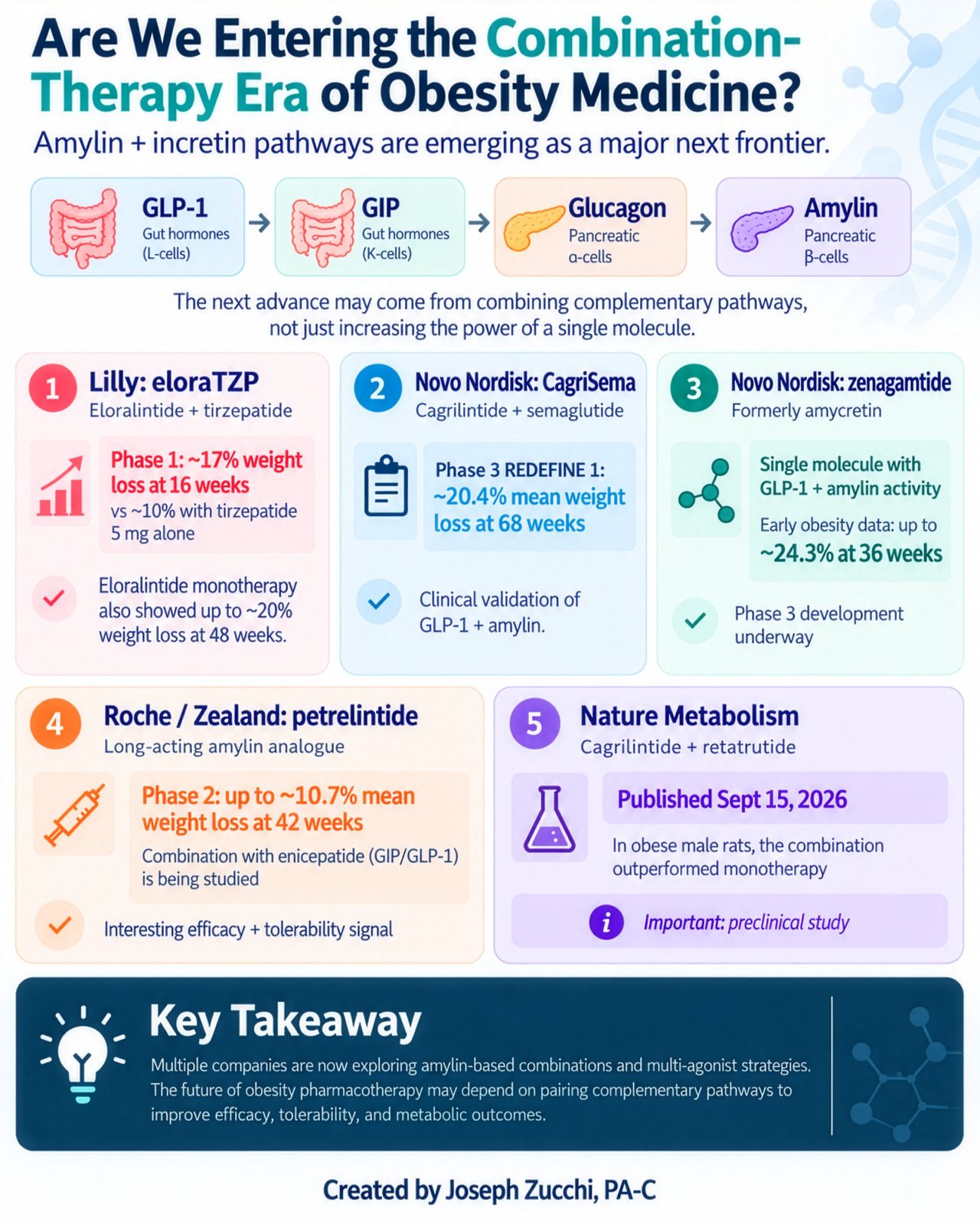
About this visual
GLP-1, GIP, glucagon, and amylin: a visual tour of complementary pathways.
Sources & further reading
Original LinkedIn post and discussion ↗
Additional references appear in the infographic and the original LinkedIn discussion.
Originally posted Sep 2026 · By Joe Zucchi, PA-C, MPAS
1280 × 1600 px · PDF includes the original image and a link to this page.
GLP-1, GIP, glucagon, and amylin: a visual tour of complementary pathways.
Original LinkedIn post and discussion ↗
Additional references appear in the infographic and the original LinkedIn discussion.
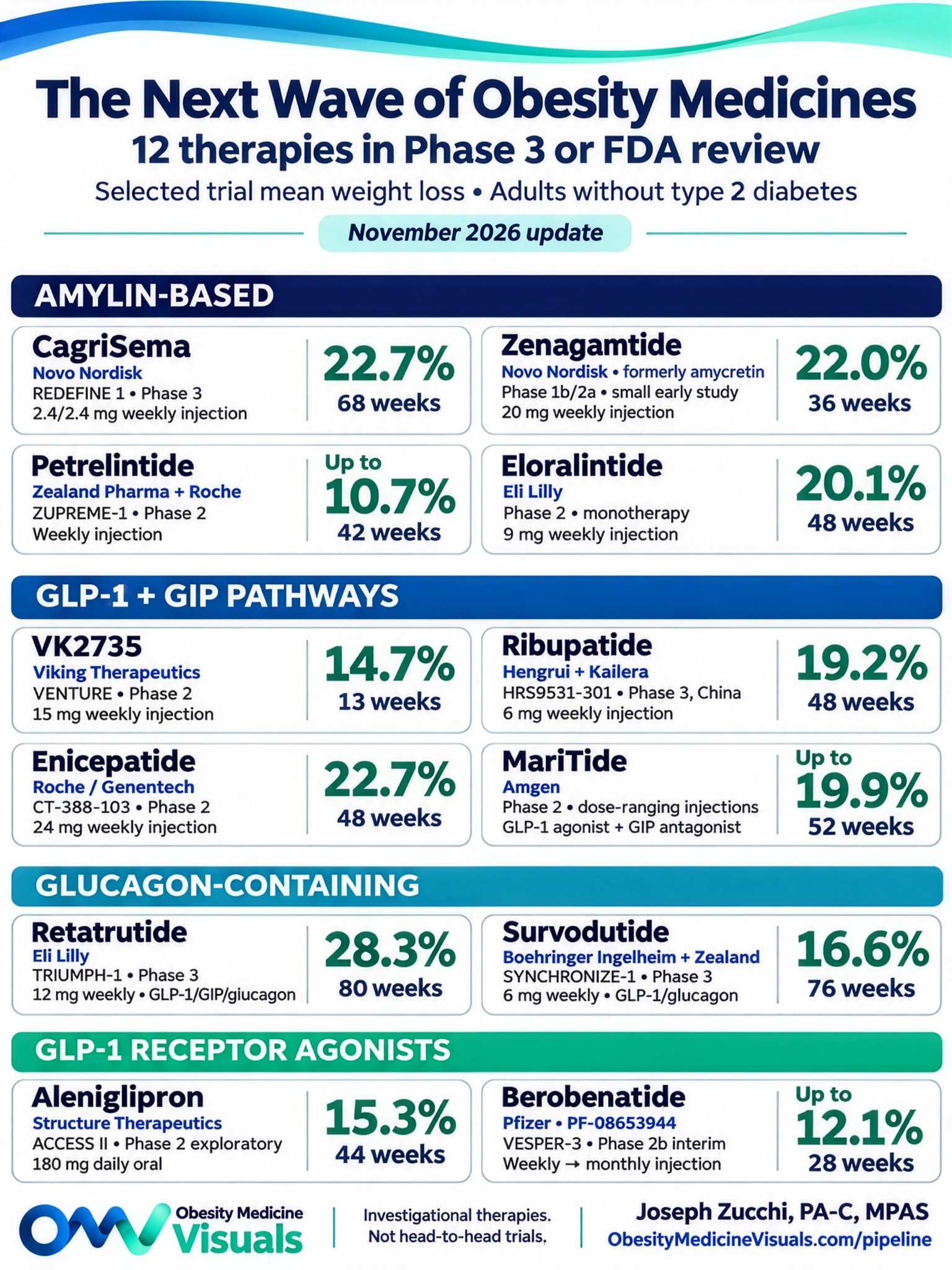
A November 2026 overview of 12 investigational obesity therapies, spanning amylin-based treatments, GLP-1/GIP pathways, glucagon-containing combinations, and GLP-1 receptor agonists.
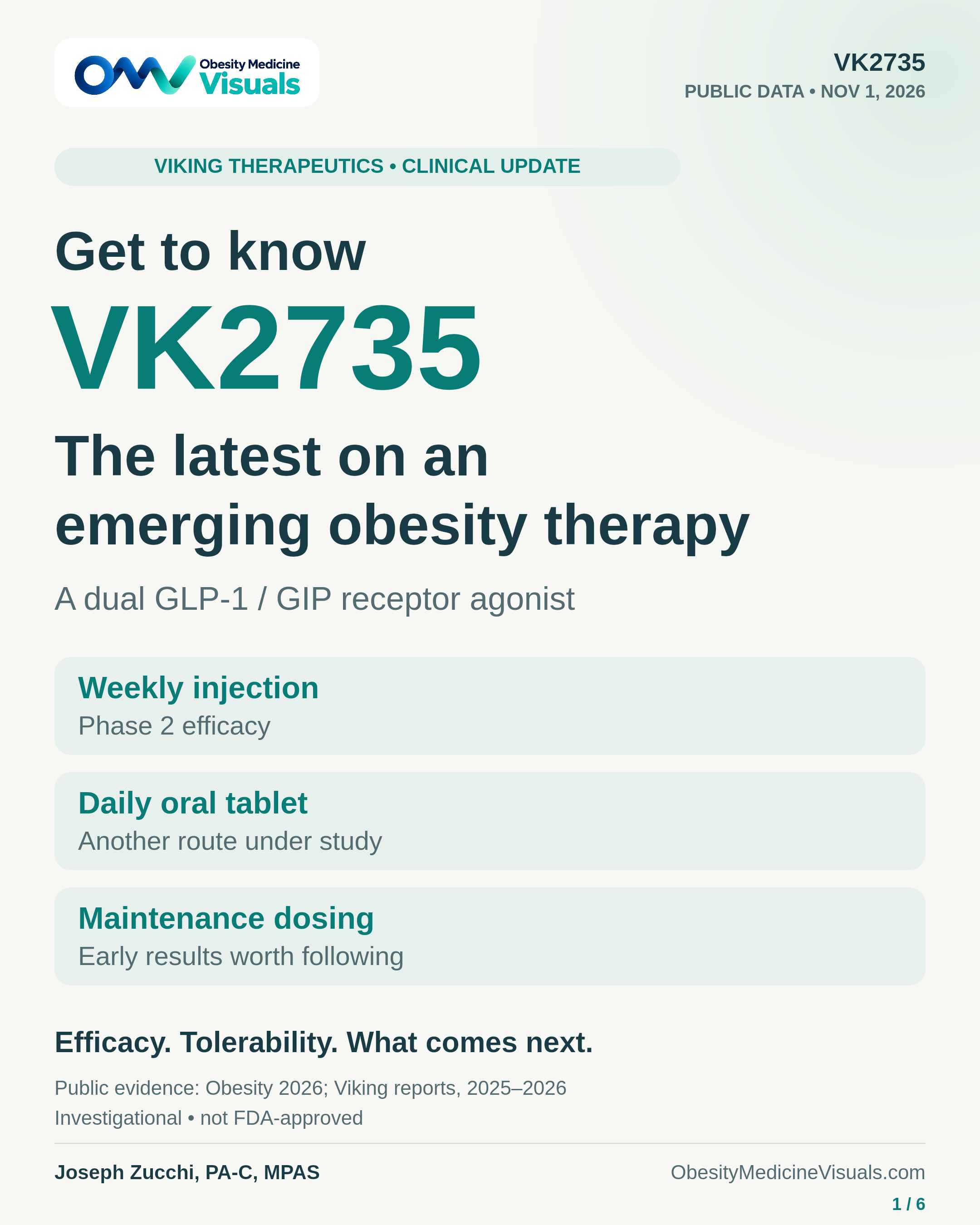
A six-slide overview of VK2735, covering injectable and oral Phase 2 results, exploratory maintenance dosing, dose-specific tolerability and Phase 3 programs.
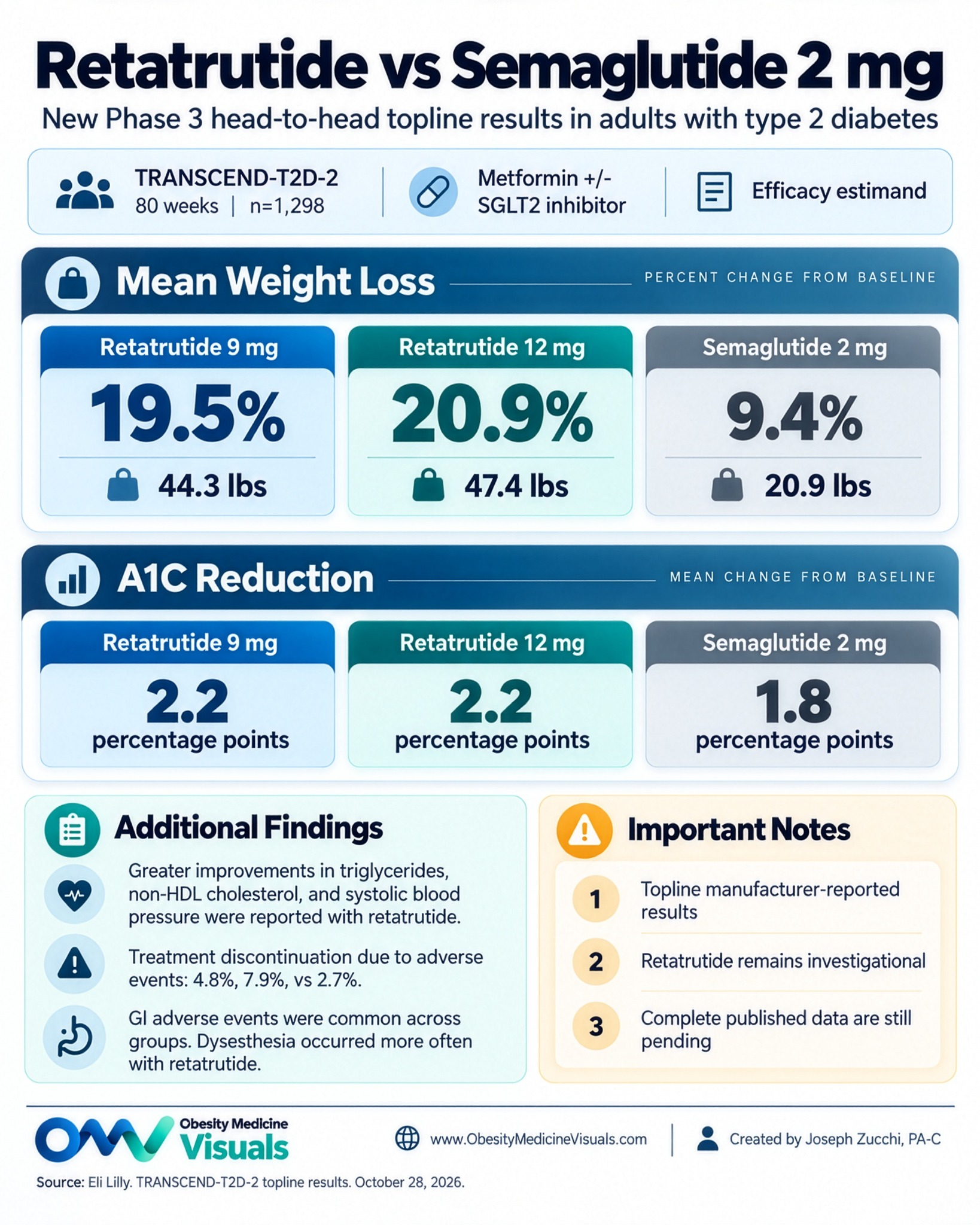
A visual summary of sponsor-reported 80-week Phase 3 TRANSCEND-T2D-2 results comparing retatrutide with semaglutide 2 mg in adults with type 2 diabetes.
Are we entering the combination-therapy era of obesity medicine?
We have already moved from GLP-1 receptor agonists to dual GIP/GLP-1 agonism and now triple GIP/GLP-1/glucagon agonism.
But another pathway is becoming increasingly important: amylin.
Several recent developments:
🔹 Eloralintide + tirzepatide (Eli Lilly and Company)
New Phase 1 data showed that adding eloralintide 3 mg to tirzepatide 5 mg resulted in approximately 17% weight loss at 16 weeks, compared with about 10% with tirzepatide 5 mg alone.
That's an impressive early signal, although it is a small, early-phase study.
We should learn much more soon: Phase 2 eloraTZP results are being presented at EASD later this month.
🔹 CagriSema and zenagamtide (Novo Nordisk)
In the Phase 3 REDEFINE 1 trial, combining the amylin analogue cagrilintide with semaglutide produced approximately 20% mean weight loss at 68 weeks.
Novo is also developing zenagamtide (formerly amycretin), which takes a different approach: rather than administering two medications, one molecule activates both GLP-1 and amylin receptors. Early studies have shown substantial weight reduction, and Phase 3 development is now underway.
🔹 Petrelintide (Roche & Zealand Pharma)
Petrelintide is another long-acting amylin analogue that produced up to 10.7% mean weight loss at 42 weeks in Phase 2.
Perhaps just as interesting as the efficacy was its tolerability profile. Roche and Zealand are now taking the next step and studying petrelintide together with the GIP/GLP-1 agonist enicepatide.
🔹 And then yesterday, a fascinating paper was published in Nature Metabolism.
Researchers combined cagrilintide with retatrutide, basically combining amylin with a GIP/GLP-1/glucagon triple agonist.
In male rats with obesity, the combination produced greater weight reduction than either medication alone and outperformed matched-dose combinations involving semaglutide or tirzepatide. Interestingly, experiments suggested the additional effect could not be explained by reduced food intake alone.
This is preclinical animal research, so it is too early to translate those results into expected human weight loss.
But the overall direction of the science is exciting!
The next generation of obesity pharmacotherapy may not simply be about finding one increasingly powerful molecule.
It may be about combining complementary pathways to improve efficacy, tolerability, metabolic adaptation, and potentially even the quality of the weight being lost.
GLP-1. GIP. Glucagon. Amylin.
We are learning much more about how these signals interact and there are now several different pharmaceutical companies testing different ways of putting those pieces together.
For those of us treating obesity, we will have more tools in our toolkit to help our patients.