About this visual
A visual summary of the announced Phase 3 findings and selected extension data.
Sources & further reading
Original LinkedIn post and discussion ↗
Additional references appear in the infographic and the original LinkedIn discussion.

Originally posted May 2026 · By Joe Zucchi, PA-C, MPAS
1280 × 1600 px · PDF includes the original image and a link to this page.
A visual summary of the announced Phase 3 findings and selected extension data.
Original LinkedIn post and discussion ↗
Additional references appear in the infographic and the original LinkedIn discussion.
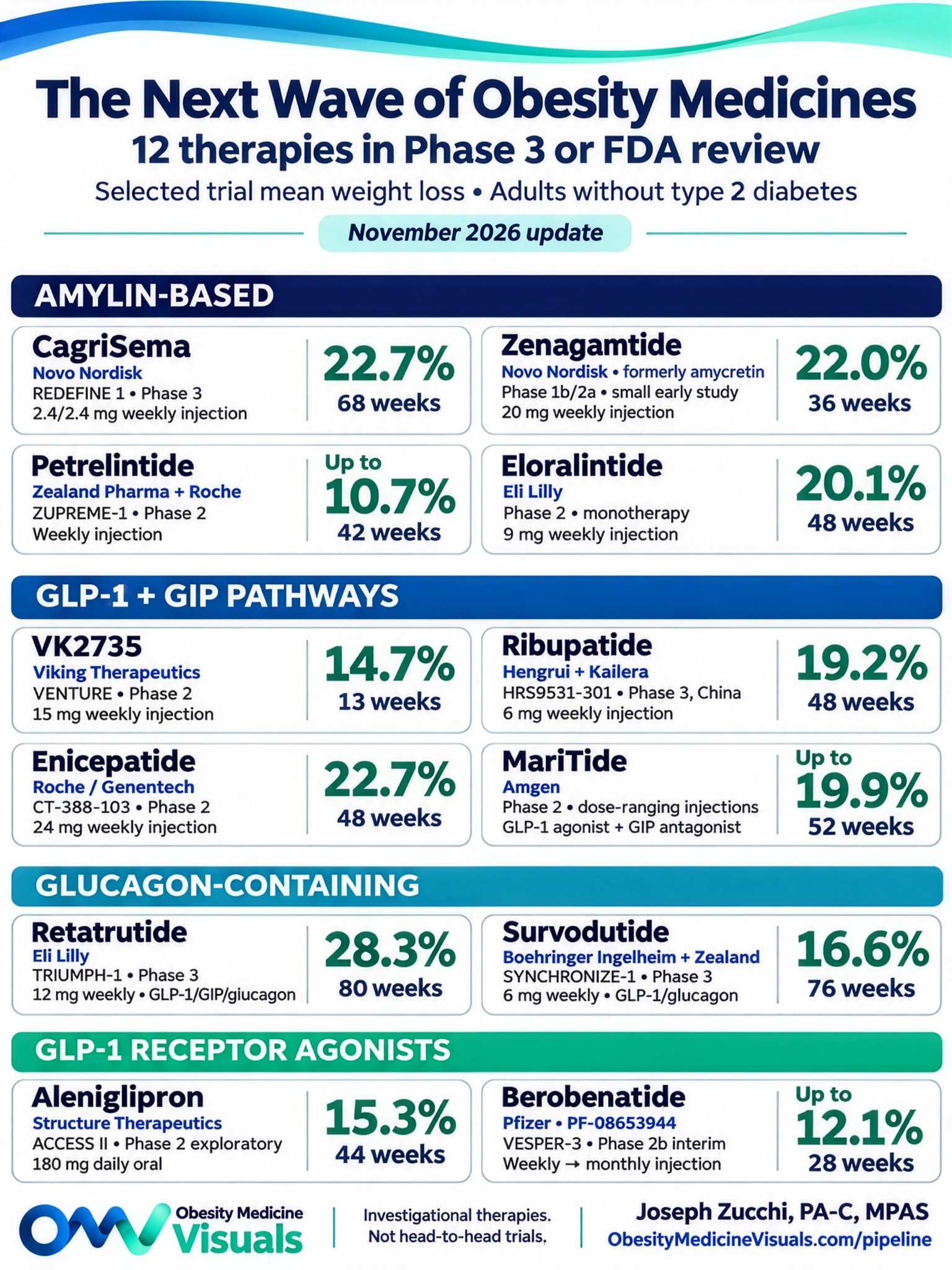
A November 2026 overview of 12 investigational obesity therapies, spanning amylin-based treatments, GLP-1/GIP pathways, glucagon-containing combinations, and GLP-1 receptor agonists.
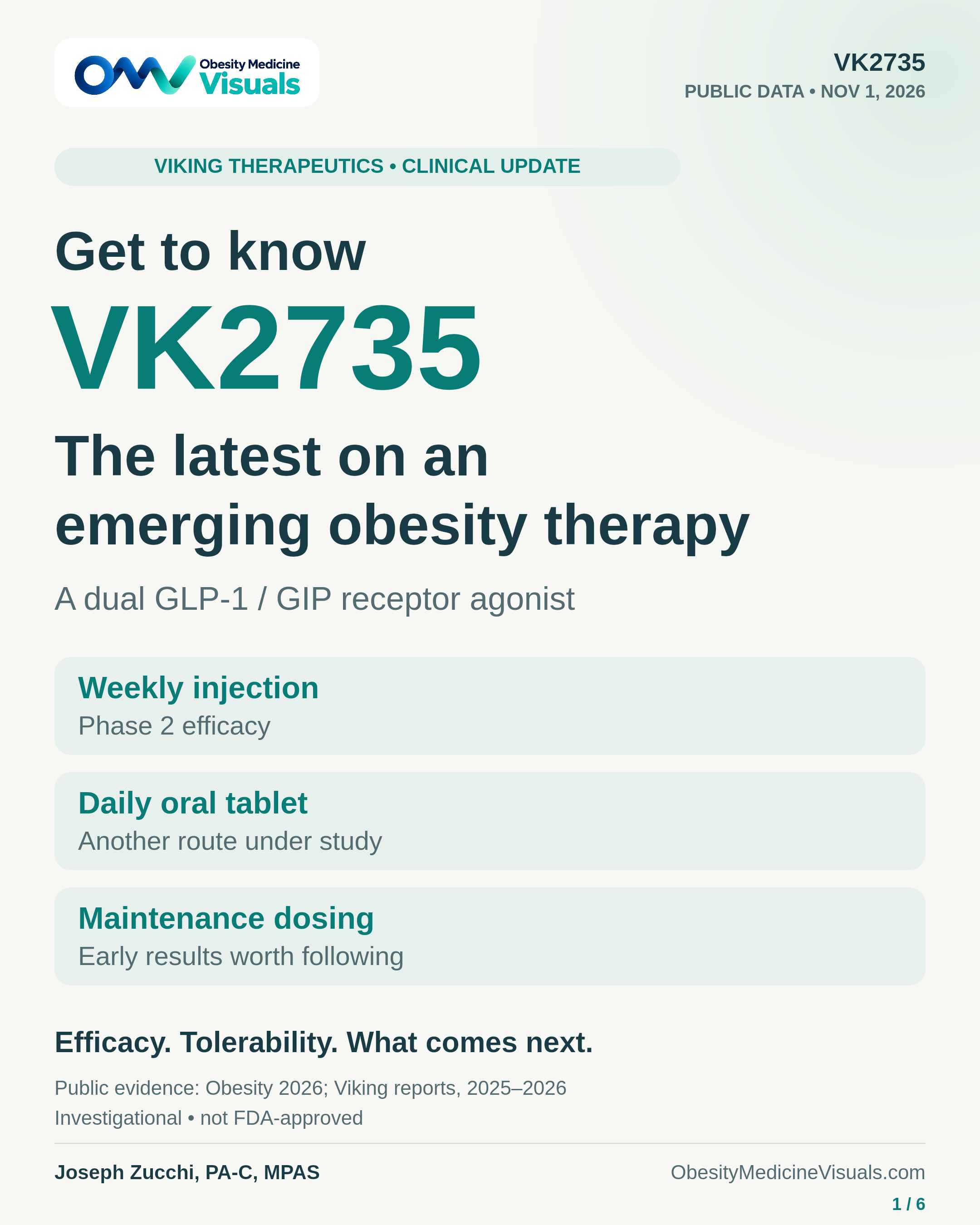
A six-slide overview of VK2735, covering injectable and oral Phase 2 results, exploratory maintenance dosing, dose-specific tolerability and Phase 3 programs.
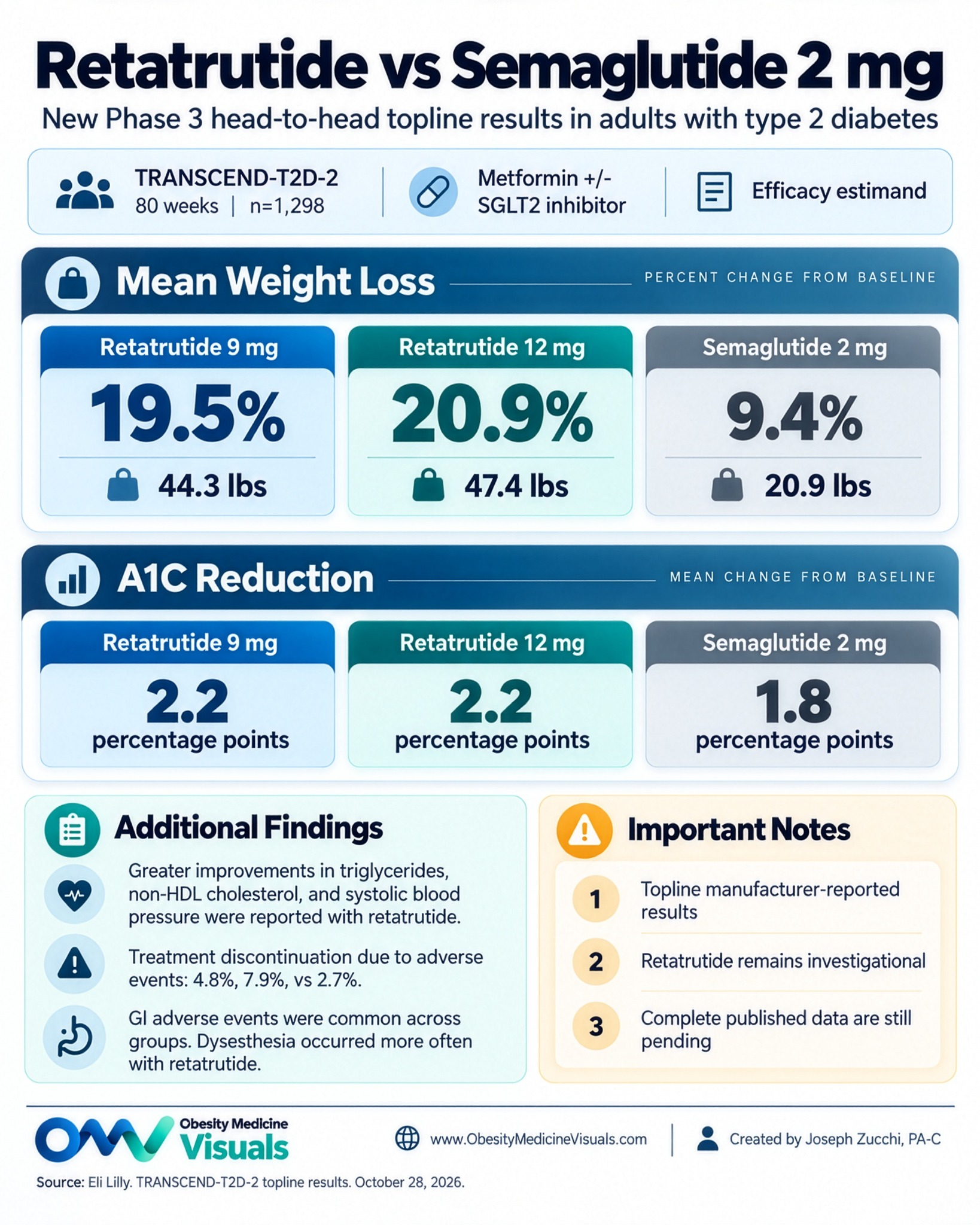
A visual summary of sponsor-reported 80-week Phase 3 TRANSCEND-T2D-2 results comparing retatrutide with semaglutide 2 mg in adults with type 2 diabetes.
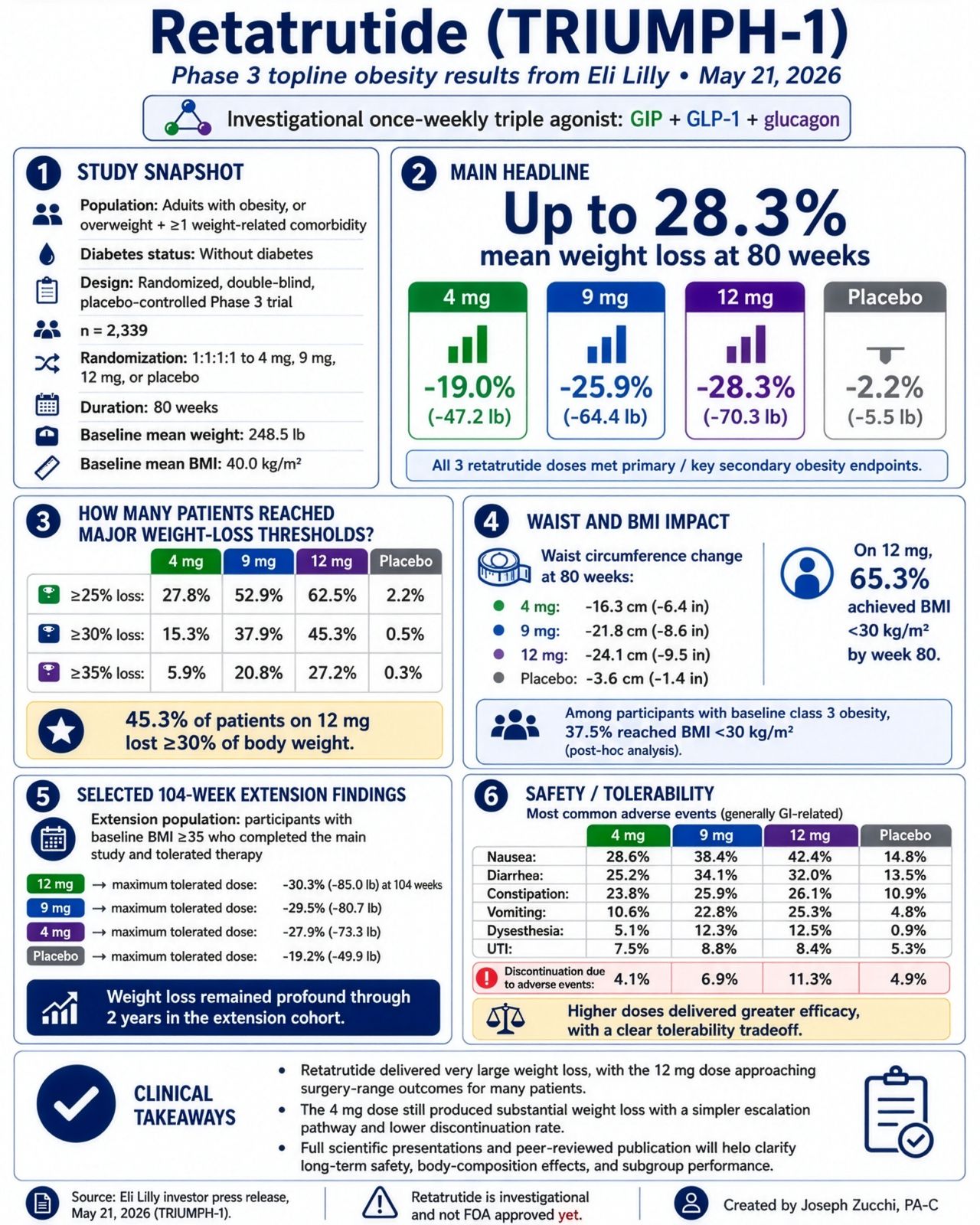
New Phase 3 obesity data just released: retatrutide showed up to 28.3% mean weight loss at 80 weeks in TRIUMPH-1.
Eli Lilly announced topline Phase 3 results for retatrutide, an investigational once-weekly GIP / GLP-1 / glucagon receptor agonist, in adults with obesity or overweight with at least one weight-related comorbidity.
TRIUMPH-1 study snapshot:
• 2,339 participants
• Adults with obesity or overweight + ≥1 weight-related comorbidity
• No diabetes
• Randomized to retatrutide 4 mg, 9 mg, 12 mg, or placebo
• Primary endpoint assessed at 80 weeks
• Pre-specified extension followed selected participants to 104 weeks
Mean weight loss at 80 weeks:
• 4 mg: 19.0%
• 9 mg: 25.9%
• 12 mg: 28.3%
• Placebo: 2.2%
For the 12 mg dose, this equaled an average loss of 70.3 lb.
Major weight-loss thresholds at 80 weeks with 12 mg:
• 62.5% lost ≥25% of body weight
• 45.3% lost ≥30% of body weight
• 27.2% lost ≥35% of body weight
Other notable findings with the 12 mg dose:
• Average waist circumference decreased by 9.5 inches
• 65.3% achieved BMI <30 kg/m² by week 80
• Among participants with baseline class 3 obesity, 37.5% reached BMI <30 kg/m²
The 104-week extension was also notable. In participants with baseline BMI ≥35 who completed the main study and tolerated therapy, those originally assigned to 12 mg and continued to maximum tolerated dose averaged 30.3% weight loss, or about 85 lb, at 104 weeks.
From a tolerability standpoint, the most common adverse events were primarily GI-related, including nausea, diarrhea, constipation, and vomiting. Dysesthesia was also reported more often with retatrutide than placebo.
One interesting detail: discontinuation due to adverse events was lower (4.1%) with 4 mg, compared with placebo (4.9%). At the 12 mg dose, discontinuation due to adverse events was 11.3%, showing the expected efficacy/tolerability tradeoff at higher doses.
Retatrutide is still investigational and not FDA approved yet, but these data represent an incredibly exciting next step in obesity medicine.