
About this visual
A closer look at prescriber experience, access barriers, and ongoing support.
Sources & further reading
Original LinkedIn post and discussion ↗
Link shared in the original post: https://lnkd.in/eazMu-kZ ↗
Additional references appear in the infographic and the original LinkedIn discussion.
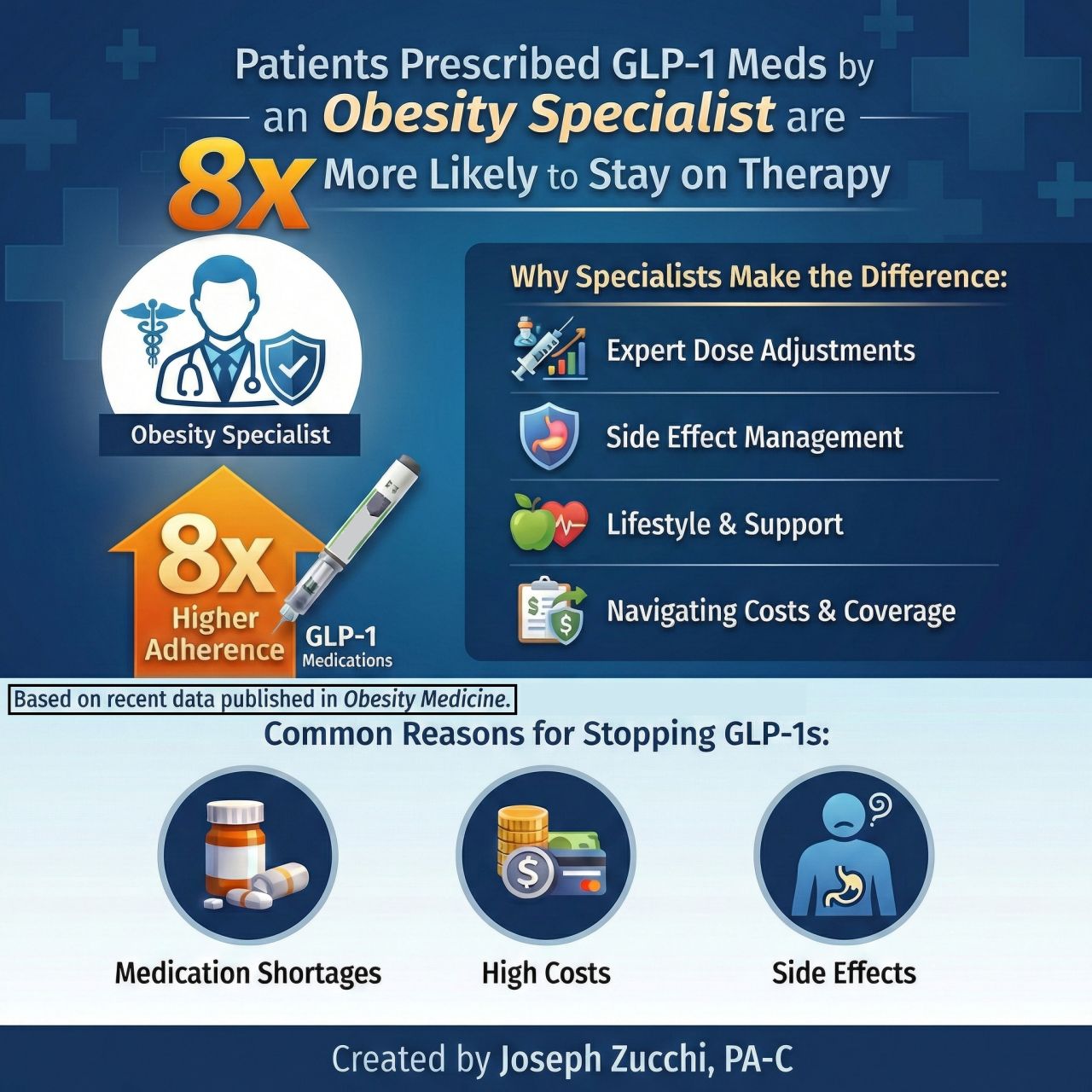
A new paper in Obesity Medicine reinforced something many of us see every day in practice: Patients prescribed GLP-1 medications by an obesity specialist were 8 times more likely to stay on therapy.
That’s a massive difference!
The study found that nearly half of patients discontinued GLP-1s within 6 months. The most common reasons were side effects, medication shortages, and cost. Not lack of efficacy.
And here’s the part that often gets lost in the headlines. High discontinuation rates are frequently framed as “patients can’t tolerate these drugs” or “they don’t work in the real world.” But this study suggests something very different:
Who prescribes the medication matters.
Obesity specialists are trained to:
- Titrate doses more thoughtfully and individually
- Anticipate and manage side effects before they derail treatment
- Set realistic expectations around timelines and plateaus
- Reinforce lifestyle strategies that improve both efficacy and tolerability
- Help patients navigate shortages, insurance changes, and cost barriers
When GLP-1s are prescribed with experience, education, and long-term support, patients are far more likely to persist.
Many of the widely cited discontinuation studies were conducted during periods of severe medication shortages, coverage instability, or without structured follow-up. That context matters. Stopping a medication because it is unavailable or suddenly unaffordable is not the same as stopping because it “failed.”
Obesity is a chronic disease. Chronic diseases require chronic management. Medications work best when paired with the right provider, the right education, and the right support system.
Link to study: https://lnkd.in/eazMu-kZ