About this visual
Exploring A1c, glucosuria, and a mathematical model of weight-loss response.
Sources & further reading
Original LinkedIn post and discussion ↗
Additional references appear in the infographic and the original LinkedIn discussion.

Originally posted Sep 2026 · By Joe Zucchi, PA-C, MPAS
1280 × 1600 px · PDF includes the original image and a link to this page.
Exploring A1c, glucosuria, and a mathematical model of weight-loss response.
Original LinkedIn post and discussion ↗
Additional references appear in the infographic and the original LinkedIn discussion.
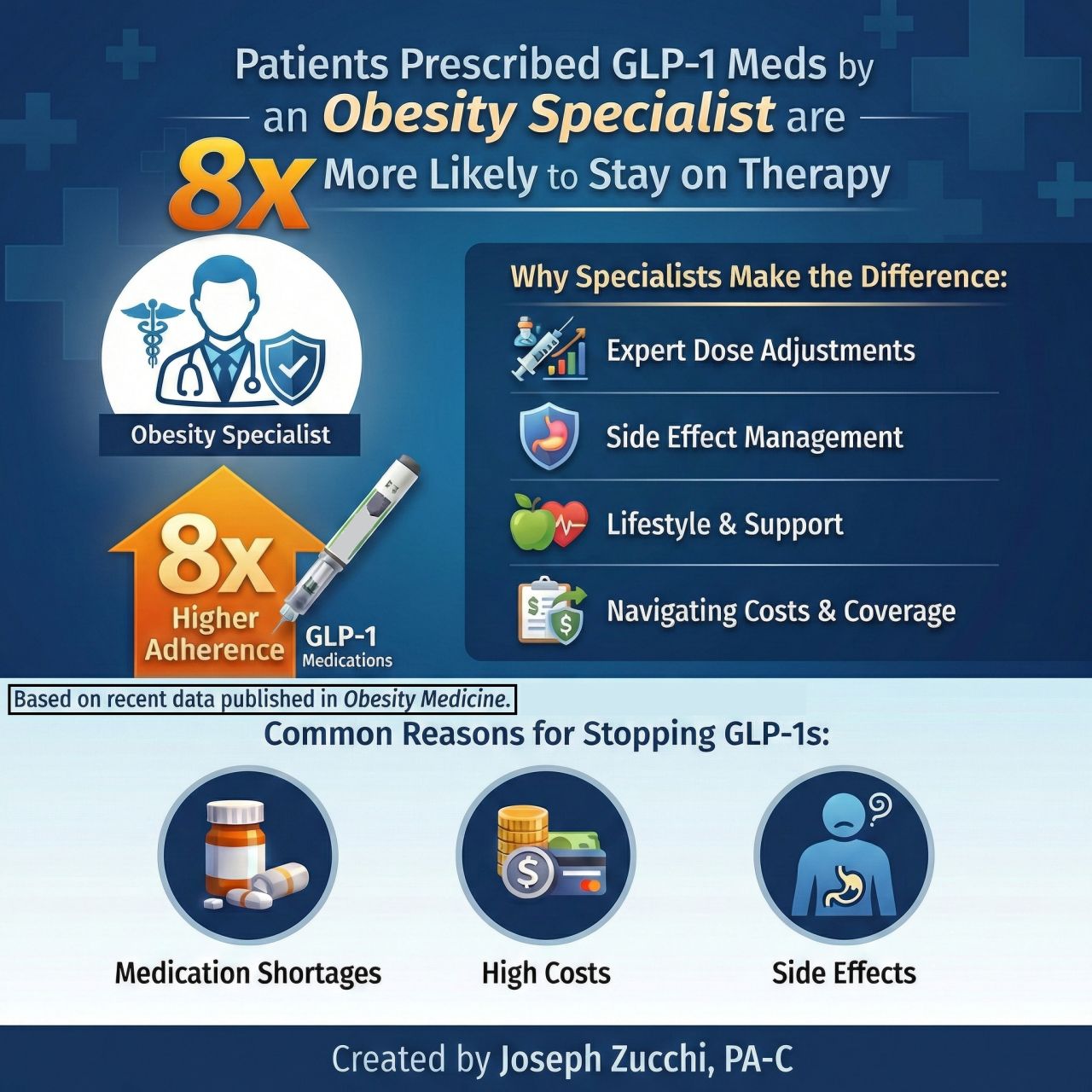
A closer look at prescriber experience, access barriers, and ongoing support.
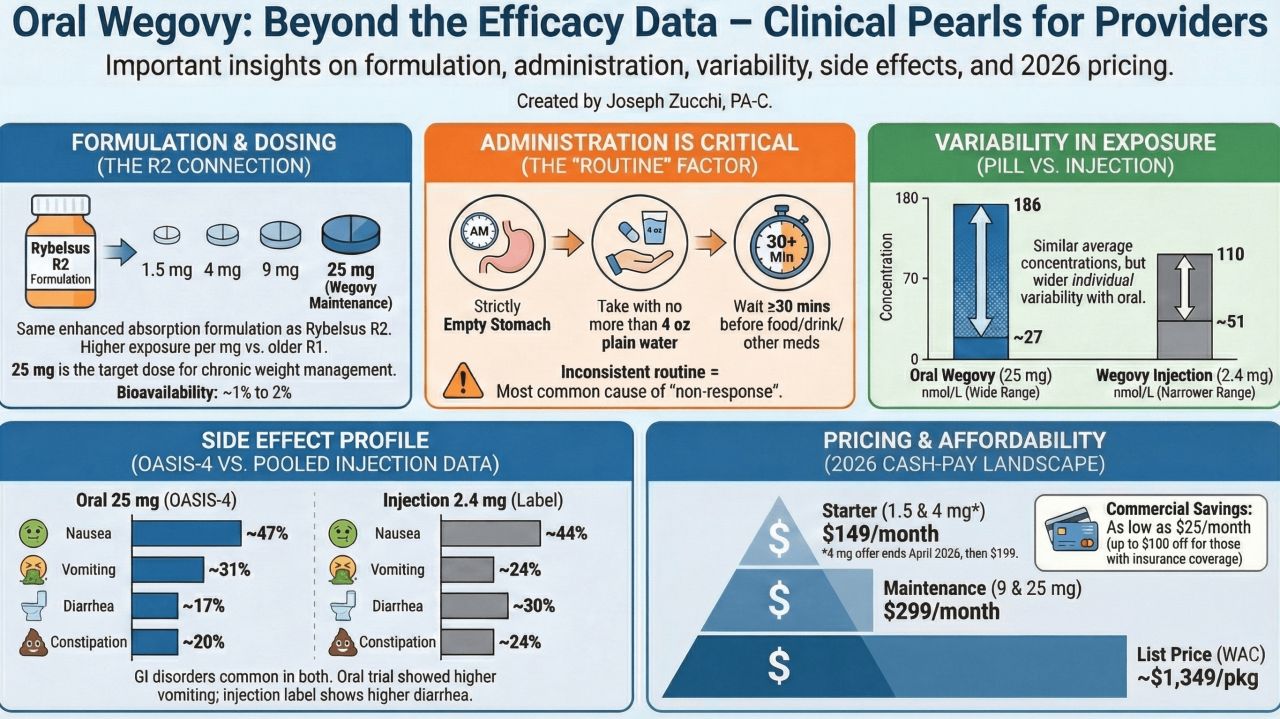
Joe’s January 2026 overview of formulation, administration, and exposure.
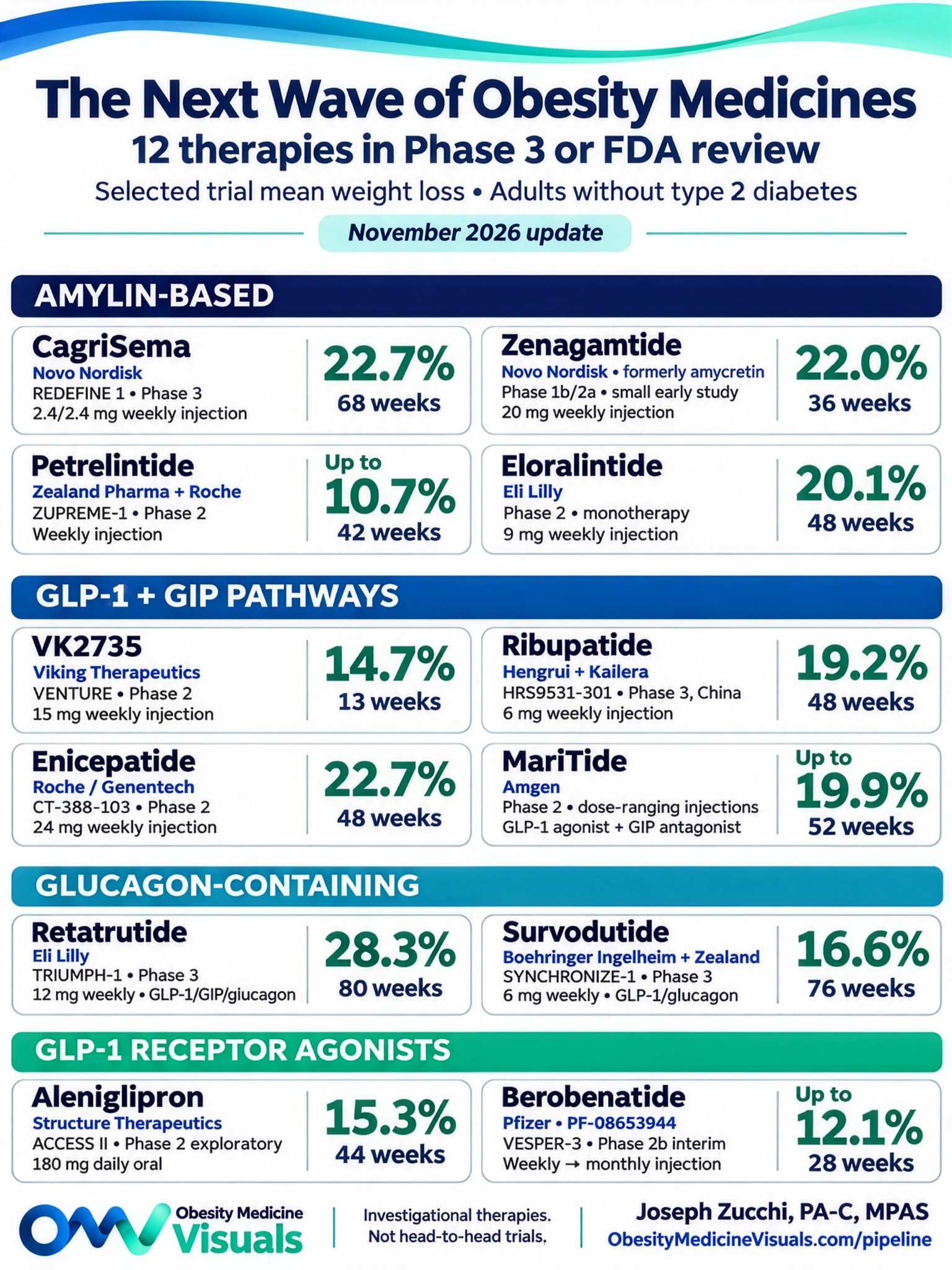
A November 2026 overview of 12 investigational obesity therapies, spanning amylin-based treatments, GLP-1/GIP pathways, glucagon-containing combinations, and GLP-1 receptor agonists.
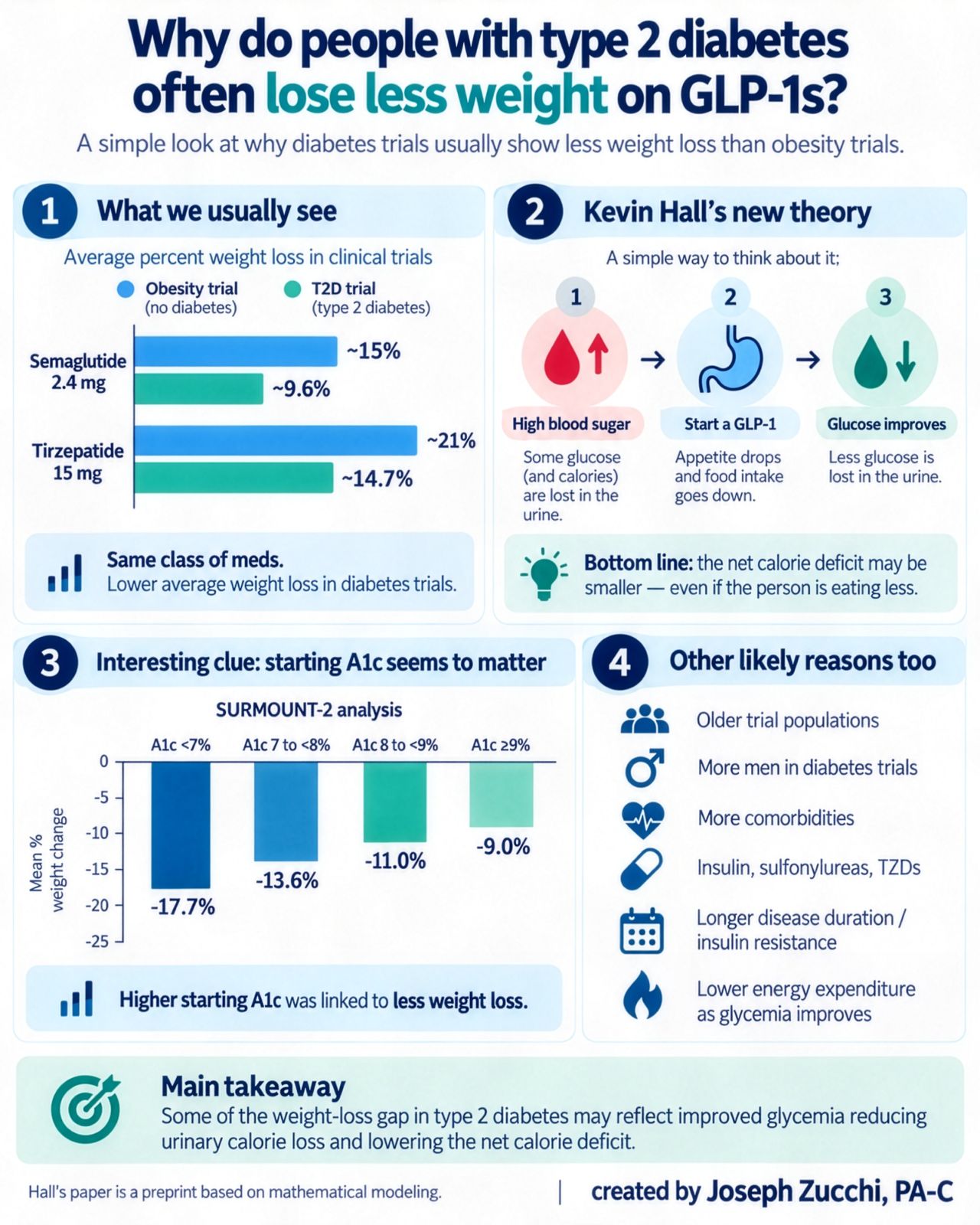
Why do people with type 2 diabetes consistently lose less weight on GLP-1 medications than people in obesity trials?
I’ve always found this interesting. We see it with semaglutide. We see it with tirzepatide. Both incretin therapies, but people with diabetes tend to lose less weight.
One of the most unique clues is baseline A1c.
In an analysis of SURMOUNT-2 with tirzepatide 15 mg, placebo-corrected weight loss was roughly:
A1c <7% → 17.7%
A1c 7–8% → 13.6%
A1c 8–9% → 11.0%
A1c ≥9% → 9.0%
That’s a pretty interesting pattern.
And the people with diabetes whose A1c was already under 7% had a weight-loss response almost identical to participants without diabetes in SURMOUNT-1.
Kevin Hall just published a new preprint looking at one possible explanation: glucose being lost in the urine. If someone has significant hyperglycemia, they can literally be losing calories through glucosuria.
Then we start a GLP-1 medication. It improves satiety, leading to less caloric intake which leads to weight loss, but their glucose also improves.
Now they lose less glucose in the urine, which means they’re actually keeping some calories that used to leave the body. There may be another piece too: poorly controlled diabetes can raise energy expenditure, and as glucose improves, that extra calorie burn may come down.
So you could theoretically have two people eating the same amount less on treatment, but the person whose diabetes dramatically improves ends up with a smaller net calorie deficit.
That doesn’t explain everything. There are plenty of other theories too.
Diabetes trials tend to include older patients, more men, longer duration of obesity and diabetes, more comorbidities, and different medication use. Insulin, sulfonylureas and other drugs can affect body weight.
There may be differences related to insulin resistance, disease duration, physical activity, or even how strongly people respond to the appetite effects of these medications.
My guess is that the real answer is probably several of these things happening at once.
But the A1c relationship is especially interesting because it makes you wonder whether some of the “diabetes penalty” we see in these trials is really a hyperglycemia penalty.
Hall’s paper doesn’t prove that. It’s a mathematical model and still a preprint.
But it’s an interesting way to think about something we see every day in obesity medicine.
Link to Hall’s paper in the comments.